Sailing has its own language, developed over centuries of practical necessity by people who needed precise words for specific parts of a vessel and specific actions performed on it. Most of this language is opaque to people who have not spent time on boats, which means that the first day aboard can feel like arriving in a country whose language you do not speak. Everyone else seems to know what a cleat is, and nobody has time to explain it because the boat is moving and the cleat is needed now.
This article is the explanation that there is never time for in the moment. The words you will hear most often on the Eighty2, what they mean, and why they are the specific words rather than simpler ones. By day two, most of this will be automatic. But day one goes better if you arrive knowing it
Directions on the Boat
Bow is the front of the boat. Stern is the back. Starboard is the right side when you are facing the bow. Port is the left side. These directions are absolute: they do not change depending on which way you are facing on the boat. Starboard is always the right side of the vessel as designed, not the right side as you happen to be standing. The reason sailing uses these specific words rather than left and right is exactly this: when you are below decks or facing aft or standing sideways to the centreline, left and right are ambiguous. Starboard and port are not.
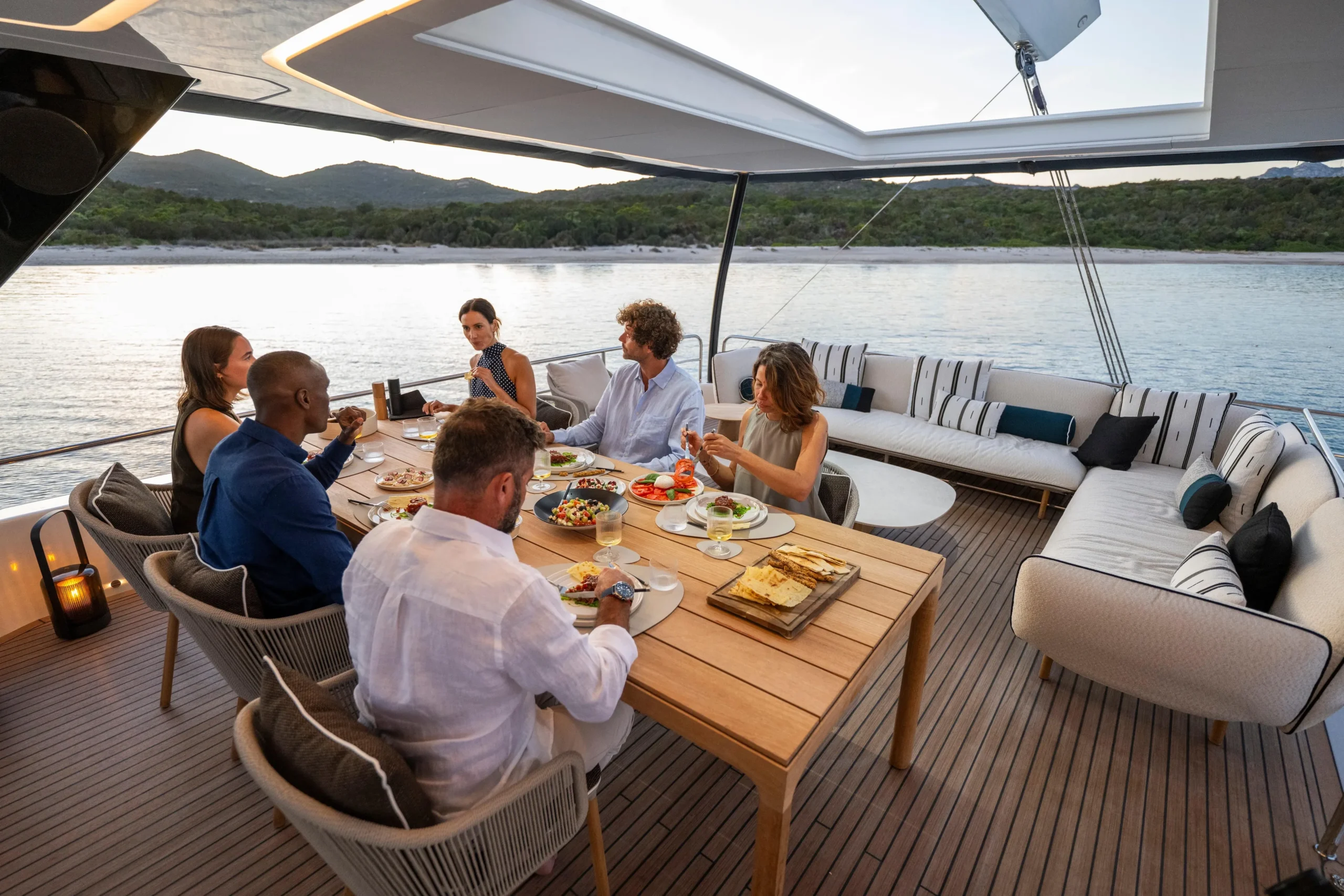
Fore means toward the bow. Aft means toward the stern. Forward and aft as directions: if someone asks you to go forward, they mean toward the bow. If they ask you to go aft, they mean toward the stern. The foredeck is the deck area at the bow. The afterdeck is the deck area at the stern, which on the Eighty2 is also the primary social space when the boat is at anchor or underway in good conditions.
Windward is the side from which the wind is coming. Leeward (pronounced loo-ward) is the side away from the wind. On a sailing boat, the windward side is the high side when the boat is heeled. On a catamaran like the Eighty2, which heels much less than a monohull, the distinction is less physical but equally navigational: knowing which side is windward tells you which direction the wind is coming from and therefore which way the boat will move if something changes.
The Sails
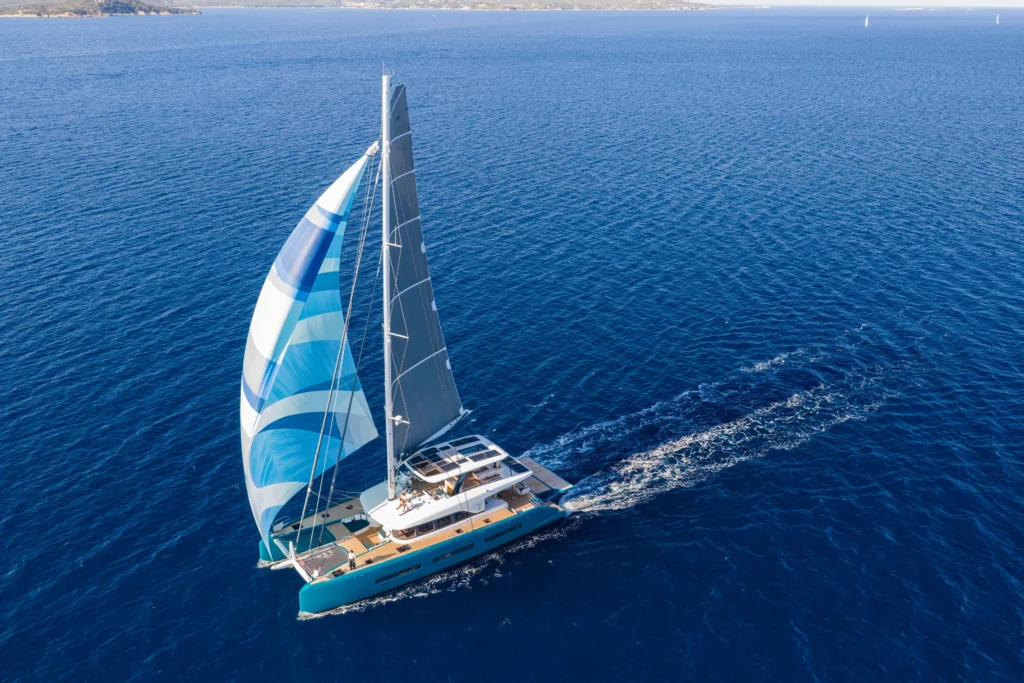
The mainsail is the large sail attached to the mast and the boom. It is the primary driving sail and the one most frequently adjusted for conditions. A reef is a reduction in sail area: when the wind increases, we reef the mainsail by rolling or folding part of it away, reducing the area exposed to the wind and making the boat easier to manage. Reefing is a safety measure, not a sign of caution: it is the correct response to increasing conditions and any competent sailor does it early rather than late.
The genoa is the large foresail, the sail at the front of the boat that works with the mainsail to drive the vessel forward. On the Eighty2 it is furled on a roller: it rolls around the forestay like a window blind, deploying and retracting as conditions require. The forestay is the wire that runs from the bow to the top of the mast, holding the mast forward and providing the attachment point for the genoa.
Sheets are the ropes that control the angle of the sails. The mainsheet controls the mainsail. The genoa sheets control the genoa. Pulling a sheet in tightens the sail and changes its angle. Easing a sheet lets it out. When someone on watch says ease the genoa sheet, they mean let it out slightly to adjust the sail trim for a change in wind angle.
Anchoring
The anchor is the device dropped to the seabed to hold the boat in position. The chain is the heavy metal chain connecting the anchor to the boat: the weight of the chain helps the anchor set correctly and provides a buffer against the jerking motion that wind and wave can generate. The scope is the ratio of chain length deployed to water depth: more scope means more chain on the bottom, which means better holding. The anchor alarm is the GPS-based alarm set on the chart plotter that alerts the watch if the boat has dragged from its anchored position beyond a set distance.
To weigh anchor is to retrieve the anchor and leave the anchorage. The expression comes from the weighing of the anchor chain as it is hauled up: the weight tells you how much chain has been deployed. On the Eighty2 the anchor windlass handles this mechanically rather than manually, which is the correct solution for a chain of the length and weight that a vessel of this size uses.
| Word | Means |
|---|---|
| Bow / Stern | Front / Back of the boat |
| Starboard / Port | Right / Left when facing forward |
| Fore / Aft | Toward the bow / Toward the stern |
| Windward / Leeward | Side the wind comes from / Side away from the wind |
| Mainsail | The large sail on the mast and boom |
| Genoa | The foresail at the front of the boat |
| Reef | To reduce sail area in stronger wind |
| Sheet | A rope controlling the angle of a sail |
| Cleat | A fitting on the deck for securing ropes |
| Scope | The ratio of chain to water depth at anchor |
| Weigh anchor | Retrieve the anchor and leave the anchorage |
| Helm | The wheel or tiller used to steer the boat |
| Flybridge | The elevated helm station on the Eighty2 |
| Afterdeck | The deck area at the stern, the social space |