The watch system is the structure that allows a sailing vessel to operate safely and continuously across ocean passages. It divides the 24-hour day into shifts during which a designated crew member is responsible for the safety of the boat: monitoring the instruments, scanning the horizon, managing the sails if conditions change, and waking the captain if anything requires it.
Without a watch system, offshore passage-making is not safe. With one, the boat moves continuously and the people aboard take turns carrying the responsibility that continuous movement requires.
On the Eighty2, the watch rotation runs in three-hour shifts. This is the system we have settled on after many offshore passages and many experiments with different watch lengths, and it is the right balance between the demands of sustained vigilance and the rest that sustained vigilance requires. Three hours is long enough to develop a genuine feel for the conditions and the boat’s behaviour during the watch.
It is short enough that the person on watch does not exhaust themselves before the relief arrives. And it divides the 24-hour day in a way that means every watch crew member rotates through all the different qualities of the day and the night across a passage of any length.
Who Stands Watch
The watch with Naora is always led by a crew member. The professional crew of the Eighty2 are certified to the offshore standards that commercial vessel operation requires, and the responsibility for the boat’s safety during a watch sits with the crew, not with the members.
This is not negotiable and it is not a limitation. It is the correct structure for a vessel carrying up to twelve people across oceans, and it is what allows members to participate in the watch without carrying the full weight of the responsibility that the passage entails.
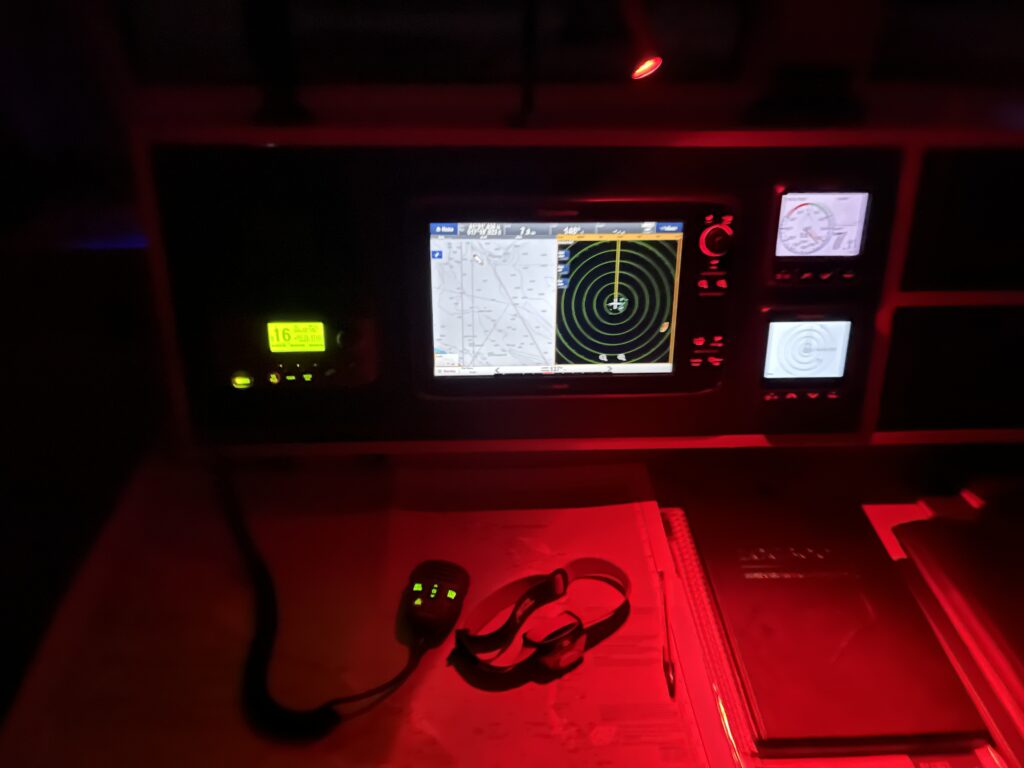
Members who want to stand watch alongside the crew are actively welcomed. The three-hour watch is one of the finest experiences the passage offers: the specific quality of a boat at night, the instruments telling their quiet story, the horizon monitored by the eye that has learned to trust itself, the specific silence that comes when the person on watch and the boat have found their rhythm together.
Members join the watch, learn the instruments, take the helm for the sections of the watch where helming is appropriate, and hand over at the three-hour mark to the next rotation.
Members who prefer not to stand watch do not stand watch. The crew rotation covers the full 24 hours without member participation. This is equally fine. The passage produces its own experience regardless of whether you spend the night at the instruments or in your berth. But the watch is available, genuinely, to anyone who wants to be part of it.
What the Watch Produces
The watch produces several things that are specific to it and not available anywhere else on the passage. The first is the quality of solitude that three hours on a boat at night gives a person who is not otherwise given to solitude: not the solitude of being alone but the solitude of being the only awake person in a small community, responsible for the moving vessel and its sleeping occupants, with nothing else to do except be present to the conditions and the instrument readings and the specific state of the night.
The second is the dawn. The morning watch on any offshore passage, starting in full darkness and ending with the sun above the horizon, contains the full range of the sky: indigo to purple to pink to gold to the clear light of a new day. The person who was on watch for that transition is the only person on the boat who experienced it continuously and completely. This is a specific and unrepeatable experience and it belongs entirely to them.
The third is the community of the watch. People who have stood watch together on the same passage share something that is difficult to put precisely into words but that every offshore sailor recognises: the specific fellowship of having been awake together in the dark with the boat between you and the ocean, responsible for the same thing, paying attention to the same information.
The watch handover, those ten minutes between the outgoing and incoming crew where the conditions and the course and the night are summarised and passed on, is a specific and intimate exchange that the social dynamics of land never produce.
When the Captain Sleeps
Sven sleeps in three-hour increments aligned with the watch rotation, with the background alertness of someone who has been sleeping on moving boats for 25 years. He is never more than a call away from the watch.
The threshold for waking him is low and explicitly stated at the evening briefing before every passage night: if anything develops that the watch crew is uncertain about, the captain is called. Not eventually, not after waiting to see if it resolves, immediately.
This is not a failure of the watch crew. It is the correct protocol for a vessel of this size and responsibility, and it is the protocol that produces the safety record that 25 years of offshore operation has accumulated.