
I have eaten well in many places and on many boats over twenty-five years of offshore sailing. I have eaten in Michelin-starred restaurants and at tables in Pacific villages where the food was cooked in a pit in the ground and served on banana leaves. I have eaten provisioned food on long passages where the fresh ingredients ran out and the staples carried the meal, and I have eaten the specific luxury of a fresh tuna sashimi twenty minutes after the fish came over the stern. All of this eating has given me a reasonably calibrated sense of what good food is and what makes it good.
What makes the food on the Eighty2 specifically ours is not any single technique or any single ingredient. It is a combination of principles that have been consistent across every meal the boat has produced, from the simplest lunch on a passage day to the most elaborate dinner at a Mediterranean anchorage in August. I want to name these principles because they are teachable and because understanding them is part of understanding what the Naora food experience actually is.
Principle One: The Source Is the Flavour
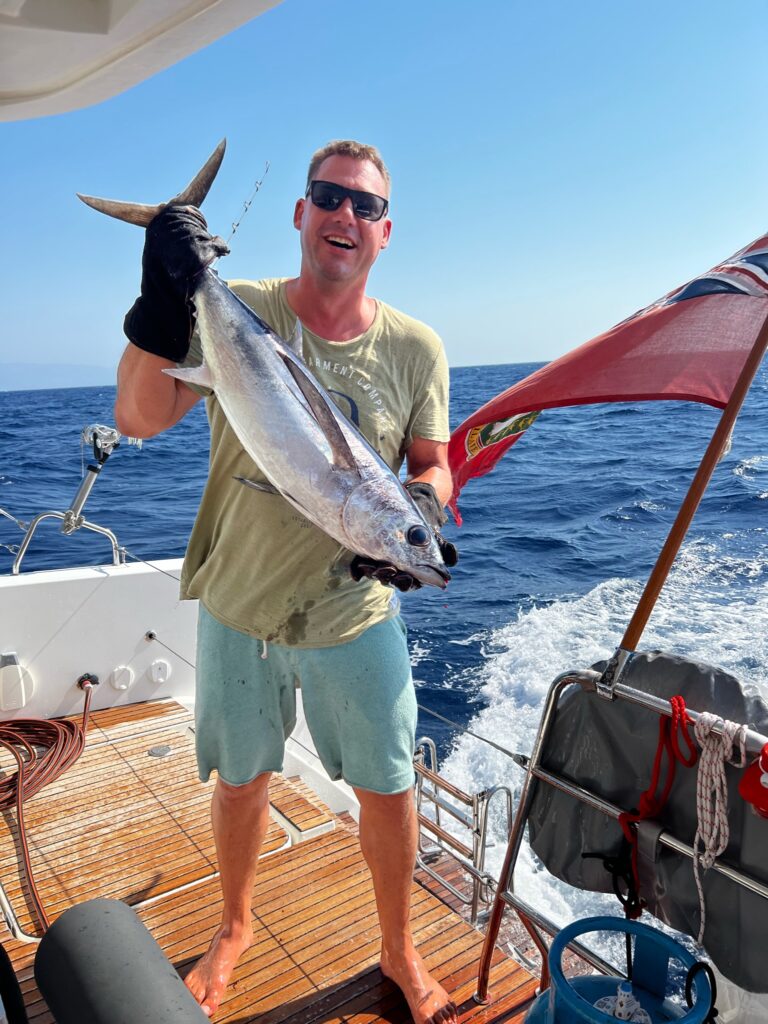
Everything we eat comes from as close to where we are as possible. Not as a philosophy but as a practical commitment that shapes every provisioning decision. The tomato from the woman at the dock in Bodrum. The tuna from the trolling line thirty minutes ago. The oysters from the rock face above the bay. The herbs from the deck garden rather than from a packet that has been in storage since the last port.
The source is the flavour because freshness and provenance are flavour. A tomato grown in the volcanic soil of a Greek island and sold by the farmer who grew it tastes different to a tomato that spent a week in a refrigerated truck because the flavour compounds that deteriorate in transport are still present.
A fish caught two hours ago tastes different to a fish that was iced for three days because the texture has not had time to break down and the flavour has not oxidised. These are not romantic assertions. They are measurable differences that anyone with functional taste can detect, and they are the reason that the food on Naora is consistently better than the food in most restaurants that spend more money on their kitchens.
Principle Two: The Context Travels with the Food
I believe that context is an ingredient, and that the same food tastes different in different contexts in ways that are not imaginary. The tuna sashimi eaten on the afterdeck of a boat anchored in a Tuamotu lagoon, twenty minutes after the fish was caught by the person who is eating it, in the specific light of a Pacific afternoon with no other boats in sight: this is a different eating experience to the same fish prepared by a better chef in a better-equipped kitchen for a person sitting at a restaurant table in Paris. The preparation in Paris is objectively superior. The eating in the lagoon is subjectively superior in a way that I maintain is not entirely subjective.
The context includes everything that preceded the meal: the passage that brought us here, the morning dive, the fishing in the afternoon, the gathering of oysters at low tide, the specific people around the table and what happened between them during the day. None of this is on the plate. All of it is in the eating. We cook in awareness of this, which means we cook to honour the context rather than to impress in spite of it.
Principle Three: The Herb Garden Is Not Optional
The herbs on deck are not decoration. They are not a lifestyle statement or a marketing element. They are a functional kitchen resource that changes the quality of every meal we produce, and their presence on the boat is non-negotiable in the same way that the watermaker is non-negotiable: because without them, the food is worse, and food that is worse than it needs to be is a failure of preparation rather than a constraint of circumstance.
Fresh basil picked six feet from the galley and used immediately retains its volatile aromatic oils in a way that basil that has been in a bag for three days does not. Fresh thyme cut from the plant and put directly into a braise has a floral herbaceous character that dried thyme approximates but does not reproduce. This is chemistry, not sentiment.
The herb garden is maintained with the same seriousness as any other onboard system because it is an onboard system: the system that produces the layer of flavour that separates the food we make from the food most boats make.
Principle Four: Simple Is Correct When the Ingredient Is Right
The most frequent mistake in cooking, in my observation, is adding complexity to an ingredient that does not require it. The wild oyster gathered this afternoon does not require a foam or a gel or a deconstructed preparation. It requires an open shell, a cold surface, and the restraint to leave it alone. The freshly caught mahi-mahi on the day it was caught does not require an elaborate sauce. It requires heat, the right fat, salt, and the herb from six feet away.
The complexity in the elaborate preparation is compensating for something that the Naora ingredients do not need compensated for: the deficit of freshness and provenance that restaurant cooking spends its entire technical vocabulary trying to overcome.
The Naora touch is therefore, at its most essential, the absence of the thing that most cooking is doing. We do not add complexity to compensate for deficit. We start with ingredients that have no deficit and we get out of their way. The result is food that tastes like what it is: a fish from this ocean, a herb from this deck, a vegetable from this island, eaten in this bay on this afternoon. That is the Naora touch. It cannot be bottled or franchised or replicated in a kitchen on land. It can only be eaten here.