The first strange thing people notice, usually around day three of an offshore passage, is that they have lost track of the day of the week. Not the date, which the GPS confirms and the deck log records. The day of the week: whether this is Tuesday or Wednesday or Thursday. It has stopped mattering in a way that reveals, by its absence, how much it was mattering before.
The day of the week is a social construct that organises life around the expectations of other people. Tuesday means certain things are open and certain things are not, certain people are available and certain people are not, certain obligations are active and certain obligations are suspended. At sea, none of these structures apply.
Every day is organised the same way: by the light, by the wind, by the watch rotation, by the meals. Tuesday and Wednesday are the same day organised by the same principles. The distinction becomes invisible because the structure that gave it meaning has been removed.
Days That Are Longer Than They Should Be
A day at anchor in a remote bay in the Tuamotu is, by the clock, the same 24 hours as a day at the office. By every other measure, it is a different order of magnitude. The morning swim before breakfast. The dive on the reef. The afternoon with a book in the shade of the mainsail. The fishing. The cooking. The meal. The conversation at the afterdeck table that runs until the stars are out. Each of these things receives the time it deserves rather than the time the schedule allows, because there is no schedule to limit it.
The result is a day that feels much longer than 24 hours in the most positive possible sense. Not dragging, not slow in the way that boredom is slow. Full, in the way that days are full when they are organised around what is actually happening rather than around what is supposed to happen next. Most people in modern working life have forgotten what a full day feels like. The offshore passage reminds them, and the reminder is sometimes disorienting in its contrast to the emptiness of a day that was nominally more eventful.
Passage Time and Shore Time
Passage time is different again from anchor time. On a long ocean crossing, time develops a specific rhythm that is neither slow nor fast but simply continuous: the watch rotation divides the day into four-hour segments, each with its own character, and the miles accumulate at a steady pace that produces a specific satisfaction.
You are always arriving. The distance to the destination is always smaller than it was four hours ago. The progress is constant and visible and produces a relationship with time that is entirely unlike the relationship that most modern work produces, where the progress is often invisible and the distance to the destination uncertain.
A two-week passage feels, in memory, like a month. Not because it was long but because it was dense: dense with weather changes, with watch conversations, with meals and fish and navigation decisions and the specific quality of twenty dawns that were each slightly different from the one before. The memory does not compress passage time in the way that it compresses time spent in routine.
The brain encodes experiences in proportion to their novelty, and a passage in open ocean across 2,000 miles is the opposite of routine. Every day is filed separately, in specific detail, which is why a month on a boat produces more distinct memories than a year in an office.
The Clock You Stop Checking
Most people check the time many times per day on land without noticing they are doing it. The phone, the computer, the microwave, the car dashboard: the time is always available and the checking is reflexive, a habit built by years of living inside a schedule that measures progress in quarter-hours and deadlines in days.
At sea, after a few days, the checking stops. Not because a decision is made to stop checking. Because the time stops being useful information. What matters is the position of the sun, which tells you the approximate time to a satisfactory precision for everything the day requires. What matters is whether the fish are active, which tells you something about the afternoon’s priorities. What matters is whether the wind is building, which tells you something about the next hour’s sail plan. None of these things require knowing whether it is 14:17 or 14:43.
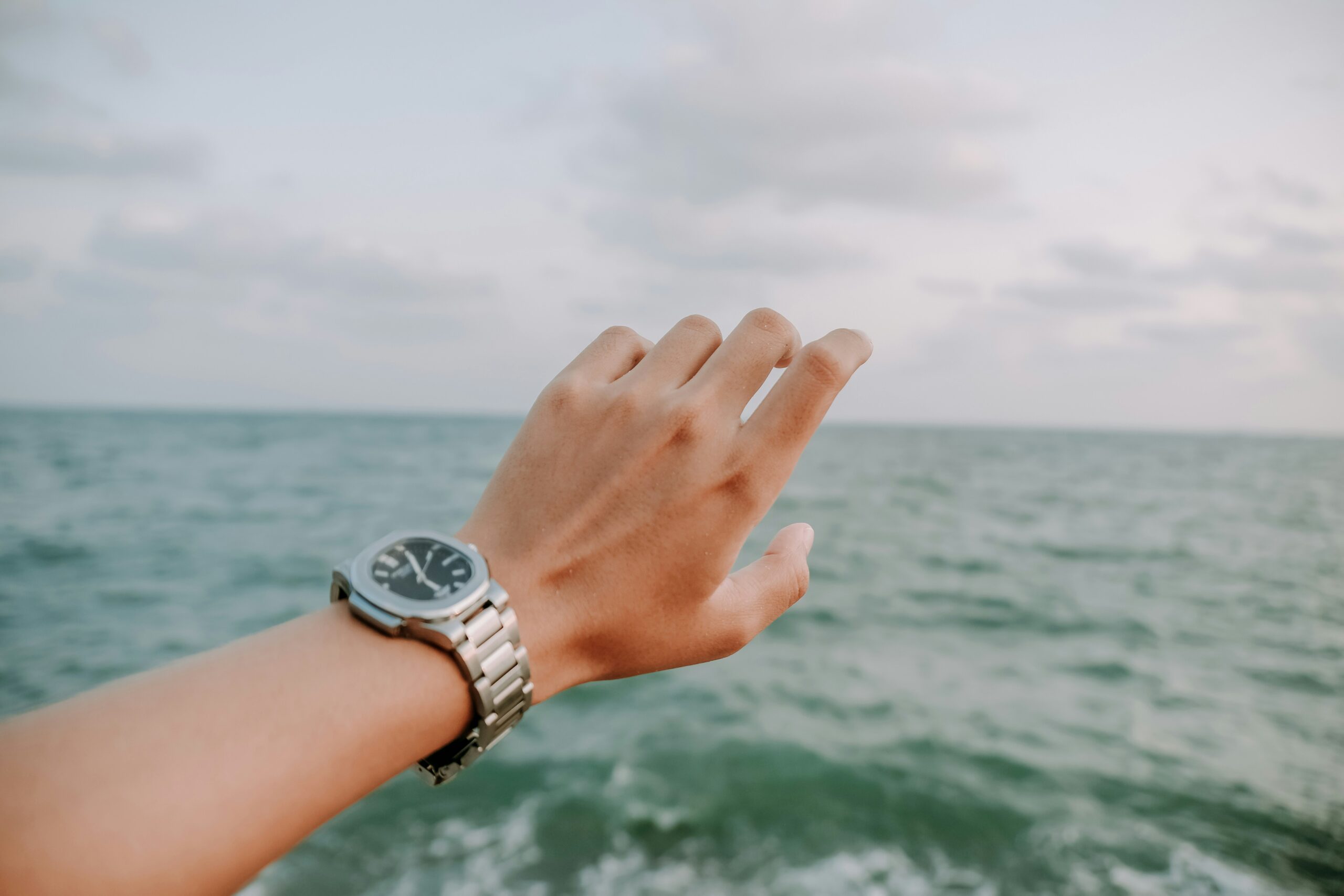
The watch is still worn. The deck log is still written every four hours with precise times. But the tyranny of the clock, the specific anxiety of time as a resource that is being consumed faster than it is being replenished, dissolves. What replaces it is the looser, more honest relationship with time that the body has when it is allowed to follow the sun rather than the schedule. This is not laziness. It is the oldest version of how human time works, and it turns out to feel extremely good after a few days of practice.