The charter is one of the finest inventions in leisure sailing. You pay a fee, a boat appears, it is provisioned and fuelled and the systems are working, and for one or two weeks you sail it from one beautiful anchorage to the next and return it and fly home. The charter model has made sailing accessible to people who could not otherwise sustain it, and the quality of the charter fleets in the Mediterranean and the Caribbean has improved to the point where the experience is genuinely excellent for what it is.
What it is, is a holiday. A specifically nautical holiday, with specific pleasures and specific freedoms. But a holiday: bounded, contained, returnable, and defined by its endpoint in a way that shapes every day within it. You are always aware, on a charter, of the day you leave. The anchorages you choose are chosen partly with that constraint in mind. The passage you might have made if you had more time is not made. The place you would have stayed another day you leave, because the return flight is already booked and the boat must be back by Saturday.
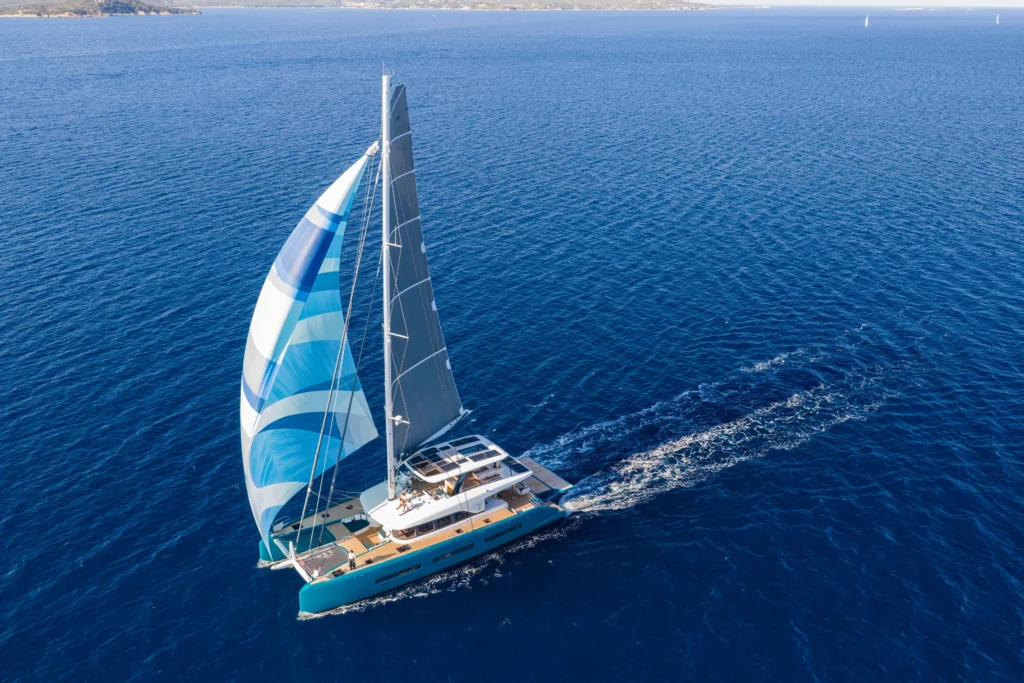
Naora is not this. The difference is not primarily one of quality, though the quality of the Eighty2 and its crew exceeds what most charter operations offer. The difference is structural, and it is the structural difference that changes everything about what is possible.
The Charter Constraint
The charter constraint is the return date, and it operates on everything. The weather window that would make an offshore passage to a more remote destination possible does not come in the right week. The anchorage that deserves three days gets one because the itinerary requires being somewhere else by Thursday. The community relationship with the village ashore that would develop if you stayed another four days dissolves because the boat must be in the marina by Saturday morning.
These constraints are not failures of the charter model. They are inherent to what a charter is. A charter is a rental: the boat is yours for a defined period and then it belongs to someone else. The defined period shapes the experience in ways that are sometimes barely noticeable and sometimes entirely determining.
The most significant thing the charter constraint eliminates is the ocean crossing. There is no charter itinerary that includes the Atlantic passage from the Canaries to the Caribbean, because no charter company operates on the timescale that an ocean crossing requires. The transformative offshore experiences, the ones that Naora is built around, are simply not available in a charter context. They require a commitment of time and continuity that the charter model, by its nature, cannot provide.
What an Expedition Adds
An expedition is defined by its purpose rather than its duration. The Naora expedition has a purpose: to circumnavigate the world over five years, to do so in the company of a curated community of people who share a specific orientation toward the world, and to do it in a way that gives each destination the time it deserves rather than the time the schedule allows.
The expedition adds three things that the charter cannot provide.
The first is continuity. The Eighty2 is the same vessel throughout the five years. The core crew is consistent. The community of members, while it rotates as people join and leave at different ports, has a continuity of culture and values that a rotating charter clientele does not produce. When you join Naora for a month in the Indian Ocean, you are joining something that has been in motion for years and that will continue to be in motion after you leave. You are not creating something from scratch for two weeks and then leaving it on the dock.
The second is access. The places that Naora visits are, in many cases, places that are not available to charter sailing. Minerva Reef in open ocean between Fiji and Tonga. The outer atolls of the Tuamotu where no charter base operates. The Banda Islands in eastern Indonesia. The Brothers Islands in the Egyptian Red Sea. These destinations require an offshore vessel with self-sufficient systems, an experienced professional crew, and the time to make the passages that access them. The charter model cannot produce any of these things. The expedition model requires all of them.
The third is community. A charter produces a group of people who share a boat for a week and part as acquaintances. An expedition produces a Circle: a community of people who have shared something real, who return to the same community at different points in the route, and who maintain the connection that offshore experience builds in the specific way that offshore experience builds it. The Long Table, the rituals, the Commodore, the Logbook: none of these things exist in a charter context because none of them have time to develop. They require exactly the continuity that an expedition provides and a charter structurally cannot.
| Charter | Naora Expedition | |
|---|---|---|
| Duration | One to two weeks | Weeks to months per member; five years total |
| Vessel | Rental, returned at departure | Dedicated vessel with consistent crew across five years |
| Community | Group assembled for the period, dispersed at end | The Naora Circle: an ongoing community that members join and return to |
| Destinations | Accessible anchorages within charter range of a base | Ocean crossings, remote atolls, offshore destinations inaccessible to charter |
| Ocean crossings | Not possible in the charter model | The backbone of the route: Atlantic, Pacific, Indian Ocean |
| Constraint | Return date shapes every decision | Seasonal logic shapes the route; individual stays are flexible within it |