I am usually awake before anyone else on the boat. Not because I set an alarm for it, though sometimes I do. More because after 25 years of offshore sailing, the body has learned that the transition between night and day at sea is worth being present for, and it wakes itself accordingly. The barometer is the first thing I check. Then the wind instruments. Then I go on deck and look at the sky.
This is not a dramatic beginning to the day. But it is the beginning of the day’s decision-making, and the decision-making does not stop until I go below at night. This is what I want to explain: what the captain’s day on a passage looks like from the inside, where the decisions are made and what they are based on and what it feels like to be the person responsible for all of it.
Before Dawn
The overnight watch has been managed by the crew watch rotation. On a passage, I am part of that rotation but I also sleep with a specific level of background awareness that is different from the sleep I get at anchor. The boat’s motion tells me things while I sleep: a change in the wave period, an increase in wind speed, the specific feel of the boat’s movement when the sails need trimming. Most nights, nothing significant happens and the watch notes are unremarkable when I read them at first light.
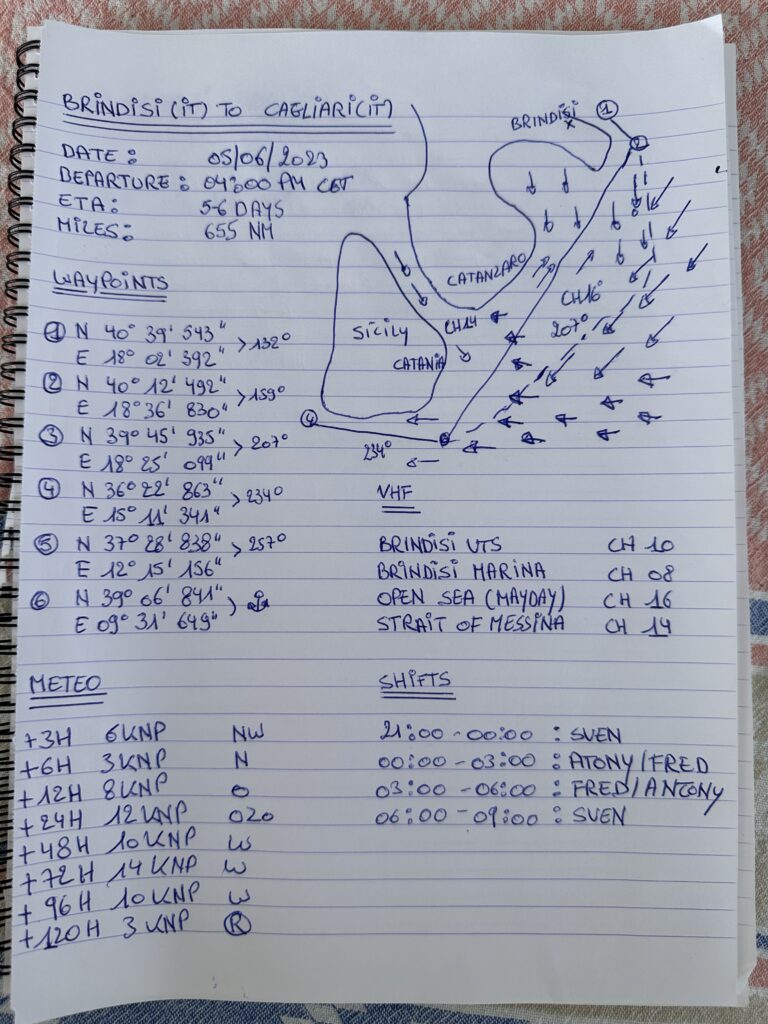
Before dawn I update the weather. The GRIB files have been downloading overnight via the satellite connection. I open the routing software and look at what the models are showing for the next 48 hours against what I expected to see when we left. Usually they agree within reasonable margins. Occasionally they show something that changes the day’s plan: a weather system moving faster than expected, a wind shift that will affect the optimal routing, a squall cluster developing ahead of us that we want to either avoid or time correctly.
I write the deck log entry for midnight and 0400 from the watch notes, then make my own entry for dawn: position, course, speed over ground, wind speed and direction, barometric pressure and trend, sea state, visibility, any vessels in the vicinity on AIS. This log is the paper record of the passage and it is written in the same format every four hours because consistency is what makes a log useful as a safety document.
The Morning
The morning systems check happens after the weather update. I go through the boat systematically: engine compartment, bilge, rigging visible from deck, sails and sheets, steering system, safety equipment. This takes perhaps twenty minutes and it happens every morning without exception. Most days nothing requires attention.
Occasionally something flags: a chafe point on a sheet that needs addressing before it becomes a failure, a small amount of water in the bilge that should not be there, a shackle that has worked loose on the running backstay. These are the things that the morning check catches early, and catching them early is the difference between a five-minute fix and a three-hour problem.
By the time the eleven o’clock meal appears, I have been managing the boat for six hours and the members are beginning their day in the way they choose. There is no tension in this: it is the division of the boat’s functions that makes the experience possible for everyone. I manage the navigation and the systems and the safety. The chef manages the food. The crew manages the watches and the deck. The members manage their own experience of the passage. Each of us does what we are there to do, and the boat functions because none of those functions overlap in ways that produce confusion about who is responsible for what.
The Decisions Nobody Sees
The decisions that determine the quality of a passage are mostly invisible to the people aboard who are not making them. The choice of the specific departure time within the weather window: leaving six hours earlier catches the tidal stream off the headland at the right state, which saves four hours of motoring into a foul current that would be avoidable with the right timing.
The routing decision that takes us thirty miles north of the direct course: the wind is forecast to back in 48 hours and the northern routing will put us in a better position for it. The decision to reduce sail at midnight rather than wait until the squall arrives: the squall arrived at 0130 and the sail was already at the right size when it did.
These decisions are made from the information available at the time, with the experience of enough previous passages to know which way the uncertainty tends to resolve. They are not always right. The weather forecast is not always right. The routing that looked optimal this morning might look less optimal by this afternoon when the next model run comes through. The capacity to make the best decision available with the current information, and to revise it without attachment when better information arrives, is the core skill of offshore passage-making. It is not dramatic. It is continuous.
The Evening
The evening passage briefing happens before dinner on passage days. Brief, specific, without drama: what the night looks like, what the watch schedule is, what I want the night watch crew to pay attention to, what the threshold is for waking me. The threshold for waking me is low. I would rather be woken three times unnecessarily than miss the one situation that needed me awake.
After dinner I am usually on deck for the sunset, which is both pleasant and informative in the ways that Céline has written about elsewhere. Then the first part of the night watch, which I often take myself because the evening watch is the one where the day’s decisions are most visible in the boat’s actual position and condition. By ten or eleven I hand over to the watch crew, go below, and sleep with the background awareness that the night requires. Tomorrow the barometer is the first thing. Then the wind instruments. Then the sky.