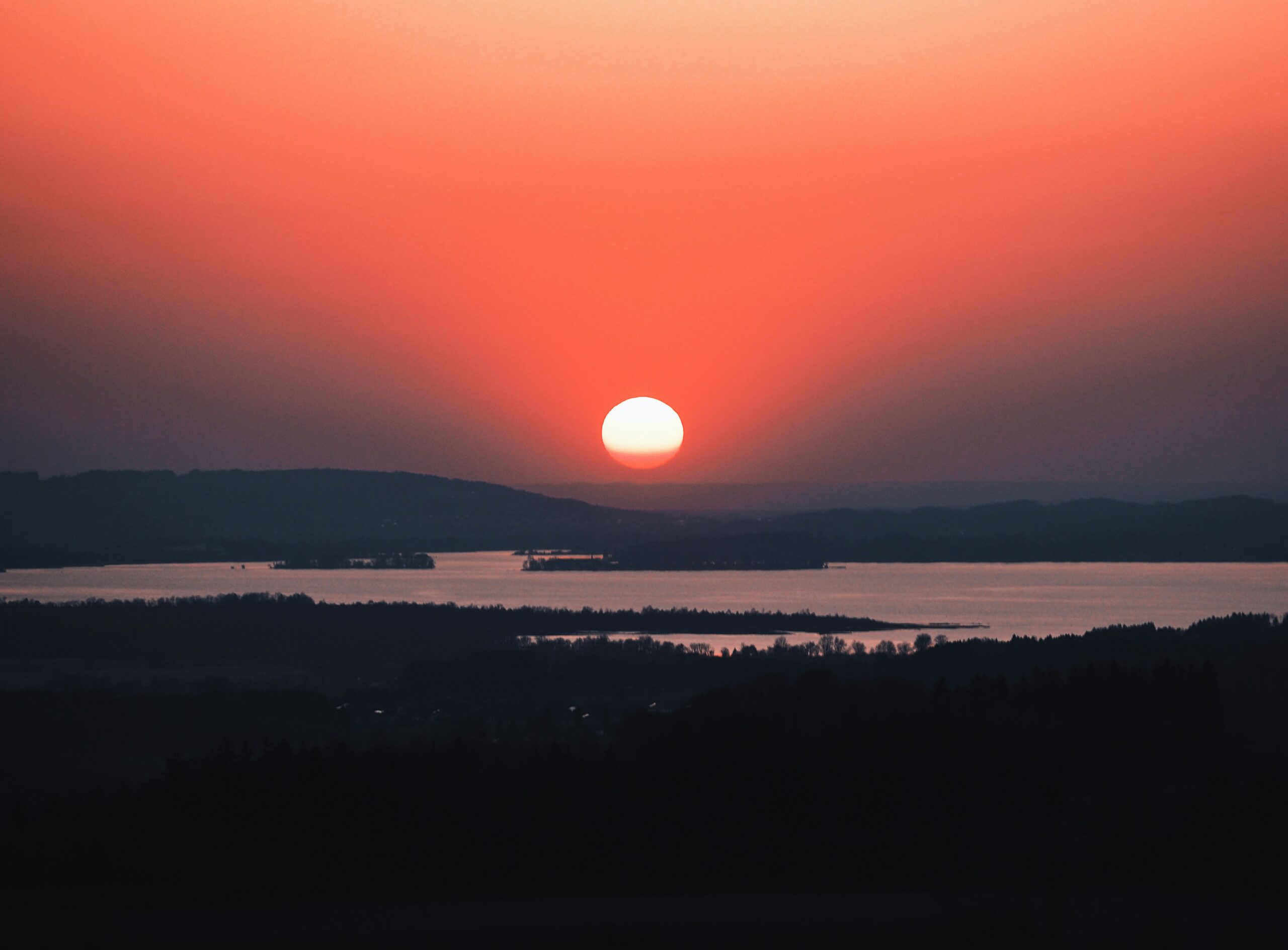
My father taught me to read a sunset before he taught me to read a chart. Not in a formal lesson, not with the intention of teaching me anything specific, but in the way that things are transmitted between people who spend a lot of time together in the same environment: by looking at the same thing and talking about what they see.
A sunset at sea is not the same as a sunset on land, and not just because the setting is different. The horizon is complete. There is nothing between you and it in any direction: no building, no hill, no tree, no other human structure. The sky and the water occupy the entire field of view, and what happens in that sky as the sun goes down happens without interruption or partial obstruction. You see all of it.
What you see, if you know what to look at, is more than beautiful. It is information.
The Colour Tells You About Tomorrow
The red sky at night saying is not folklore. It is meteorology compressed into a rhyme. A deep red sunset, particularly when the red extends well above the horizon into the higher atmosphere, typically indicates that the air to the west is dry and dusty, which in most mid-latitude situations means the pressure is high and the next day will be fine. A pale, washed-out sunset, or one where the colours are diffuse and the horizon is not sharp, often indicates moisture in the air, which in sailing terms is worth noting.
My father reads the colour and the sharpness of the horizon together. A hard, clear horizon at sunset, where the line between sky and water is precise and the sun sets into it cleanly, is a good indicator. A soft, indistinct horizon, where the line blurs as the sun approaches it, or where the sun disappears into haze before it reaches the water, is worth watching. Not alarming. Worth watching.
The green flash, which really exists and which I have seen perhaps a dozen times in my life, appears in the last second of the sun’s disappearance below a clean horizon in clear air. It is brief, specific, and requires exactly the right conditions: dry air, clean horizon, the eye already focused on the precise point where the sun is going to set. Most people who look for it miss it. Most people who see it were not entirely looking for it but were looking at the right thing anyway.
A red sky at night is a sailors man delight, while a red sky in the morning is a sailors man warning!
The Cloud Architecture
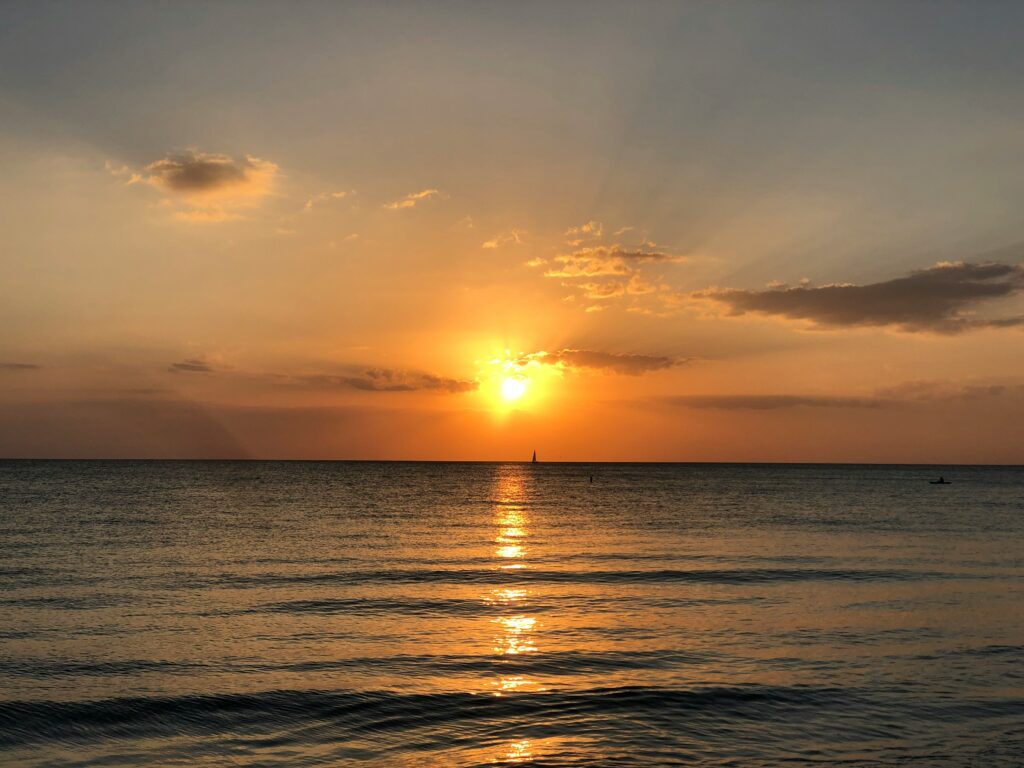
The clouds at sunset are the other source of information. High cirrus, the thin streaky clouds that appear at altitude and catch the last light after the sun has gone below the horizon, painting the sky in pink and gold long after the event itself: these are typically formed by the outflow of distant weather systems or by high-level moisture in a generally stable atmosphere. They are among the most beautiful things in the sailing sky and in stable trade wind conditions they are usually benign.
The cumulonimbus tower on the western horizon at sunset, the one with the flat anvil top and the dark base, is a different story. That is a storm system, and the question is whether it is moving toward you or across your path or away from it. My father watches the tower’s movement relative to a fixed point on the horizon, typically the forestay, for several minutes to determine the answer. If the tower is staying in the same position relative to the forestay, it is moving directly toward or away from the boat. If it is moving left or right, it will pass ahead or behind.
This is not complicated information. But it is the kind of information that requires a quiet minute of attention at sunset every evening, which is exactly the kind of attention that life at sea trains into you over time.
What Sunsets Accumulate Into
After enough sunsets at sea, they stop being individual events and start being a continuous record. You remember the sunset in the Tuamotu where the water was so flat that the reflection of the sky was indistinguishable from the sky itself. The sunset on longer crossings where the squall line was visible to the north and the sky to the south was clear and the line between them was sharp enough to have a physical presence. The sunset in Croatia in September when the Milky Way appeared before the light was entirely gone and someone on the afterdeck said something quietly that nobody answered because there was nothing adequate to say.
These are not the same sunset. But they are part of the same practice: paying attention to the sky at the end of the day, reading what it says, and then sitting with it for a minute before the watch rotation begins and the evening moves toward dinner and darkness and the night passage ahead.
My father still watches every sunset from the deck when we are underway. He reads it every time. Sometimes he says something about what it means for tomorrow and sometimes he says nothing. Both responses are the right response. The sunset does not always have a message. Sometimes it is simply the most extraordinary thing that is happening in any direction, and the correct response is to look at it until it is over