There is a moment that happens every time I take the tender out alone in the evening and turn back toward the boat. It is the moment when I stop paddling and just look. The anchor light at the top of the mast, white and steady, reflected in the water below it. The outline of the hull against whatever the sky is doing. The warm glow from the saloon portholes if people are still up, or the darker shape of a boat whose crew has gone to sleep. The whole thing sitting quietly in the bay, which was empty on a chart this morning and is now, simply, where we live.
I have been looking at boats from the water at night for as long as I can remember. It is one of those perspectives that you cannot get from aboard, and that changes something in how you understand what the boat is.
The Anchor Light Itself
The anchor light is the most basic navigation light on a vessel. A single white light, visible in every direction, hoisted to the masthead when the boat is at anchor to tell any other vessel in the darkness that something is there, stationary, in the water. It has no romance in its technical definition. It is a safety requirement.
But from the water, from a tender in the dark, it is something else. It is the specific signal that means: the boat is there. The boat is safe. Everyone aboard is in the same place. Whatever the day produced, the crossing or the anchorage or the long lunch ashore or the dive that went deeper than planned, it ended with the anchor down and the light on and the boat sitting quietly in the water doing what boats do when they are not being asked to do anything else.
I find the anchor light one of the most reassuring sights in the world. Not because anything dramatic has happened to make it reassuring. Simply because it is there, and steady, and means that the thing I care most about in terms of where I am tonight is in the right place and I am about to return to it.
The Bay at Night
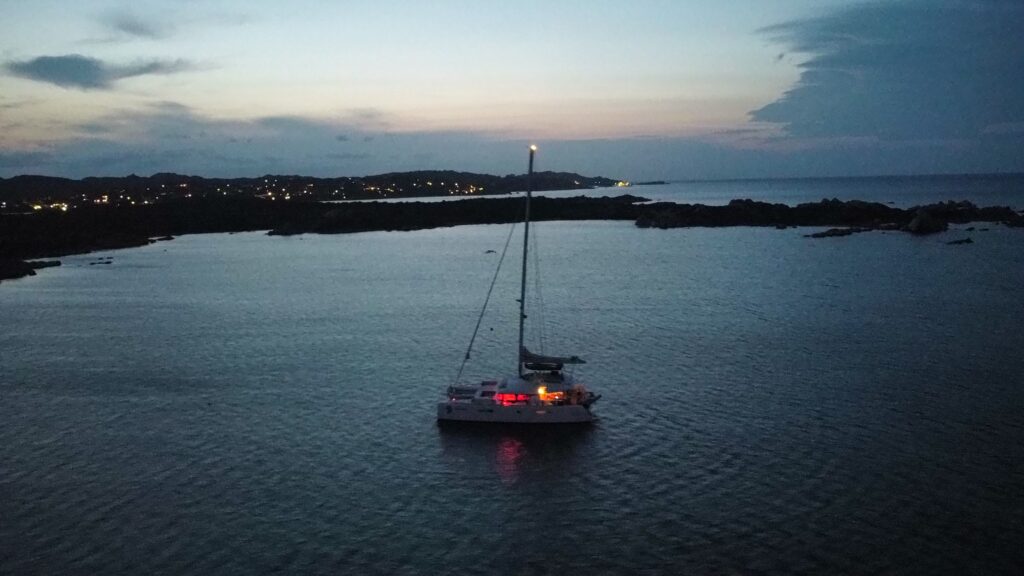
The bay at night is a different place to the bay in the afternoon. In the afternoon, the water is visible and textured and the hills behind are green or dry or pine-covered depending on where we are. At night, the bay is defined entirely by the lights within it: the anchor lights of the boats, the occasional light from a house ashore if there is one, the stars reflected in the flat water if the conditions are right. Everything else is suggested rather than visible.
Some of the finest bays I know look most extraordinary at night, from the water. The Gokova Gulf in Turkey, where the pine forest comes to the water’s edge and the only lights are the anchor lights and the stars, and the darkness between the boat and the shore is complete and soft rather than threatening. A Tuamotu lagoon where the flat water of the interior reflects the sky so accurately that the horizon disappears and the stars appear to extend in every direction including downward. A Croatian bay in September where the boat is the only thing in the anchorage and the village light on the hill above is the only other point of reference.
From the tender, rowing back toward the anchor light, these bays have a quality that I think about when I am on land and trying to explain to someone who has not been offshore why the sailing life is not primarily about the sailing. It is about the places. And the places are most completely themselves at night, from the water, when the only thing that locates you is a single white light at the top of a mast that means home.
Coming Back
The return to the boat in the evening, by tender from ashore, is one of my favourite transitions of the sailing life. You have been in the village, or on the path above the anchorage, or at the fish market in the port, or simply walking to stretch legs that have been on a boat for three days. You come back to the water. You get into the tender. And you row or motor toward the anchor light and the boat gets larger and more specific as you approach, and the sounds change from whatever shore sounds were around you to the sounds of the boat: the water against the hull, the rigging, the quiet mechanical life of something that has been sitting in the same place since you left it.
The person who hands you the stern line when you come alongside knows where you have been and does not necessarily ask. The question will be answered over dinner. The tender gets tied off. You climb aboard. The boat is exactly as you left it, which is to say: the anchor is still holding, the anchor light is still on, and the specific quality of being back aboard, after even a few hours ashore, is the quality of returning to something that fits around you in a way that shore things rarely do.