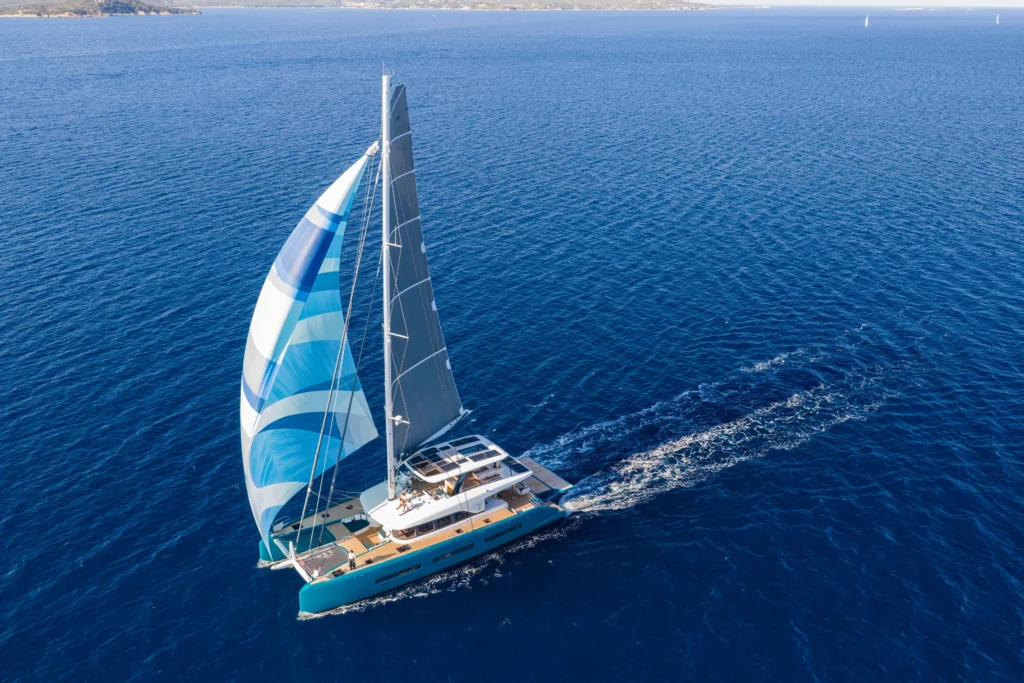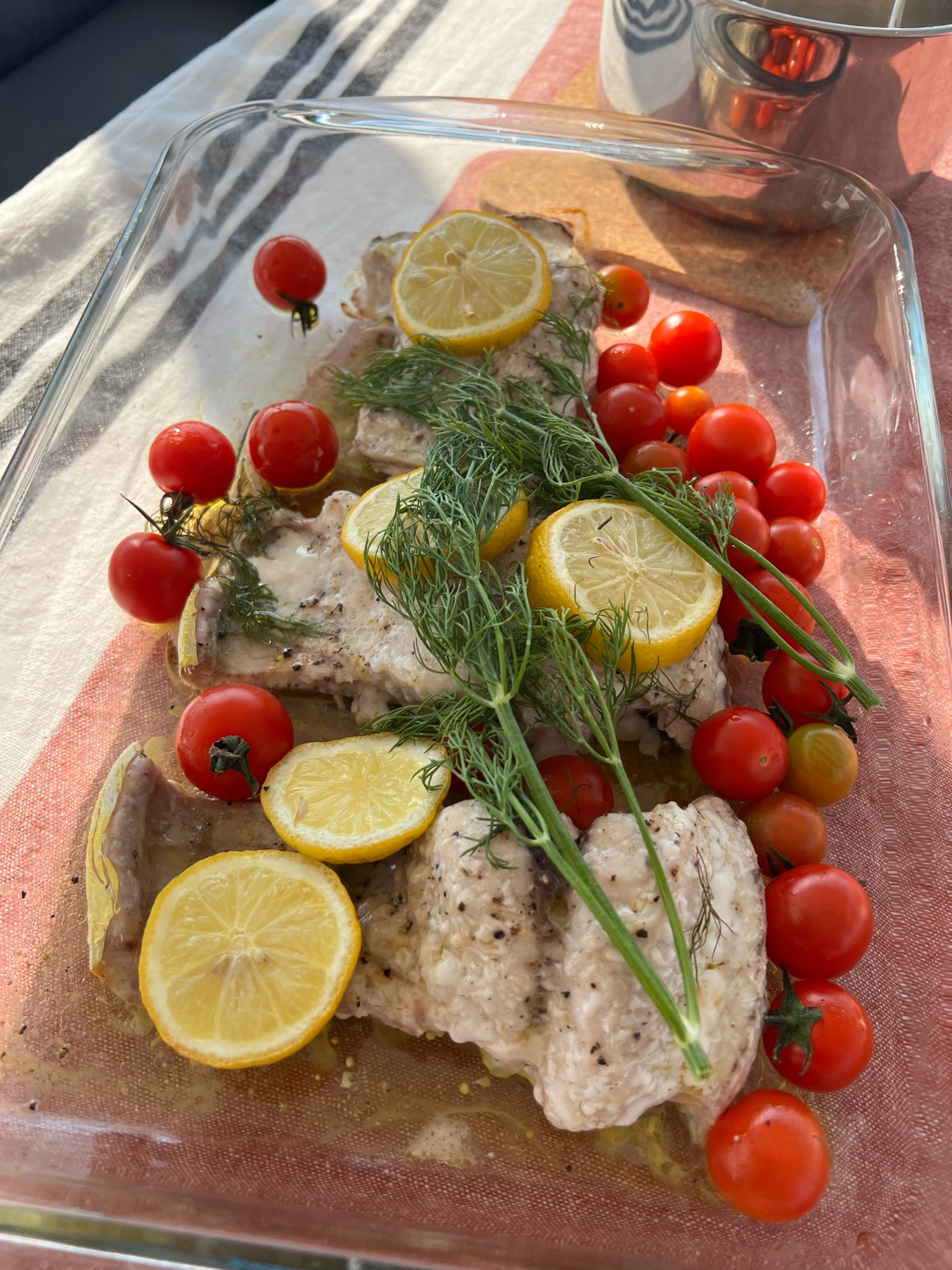
Before Naora had a dedicated chef, we cooked ourselves. My father, mom, me, whoever was aboard at the time. The galley was the same galley. The fishing line was the same fishing line. The herbs were already growing on deck because my father has always grown herbs on deck, on every boat, as long as I can remember. What was different was the process: no professional, no mise en place, no one responsible for the eleven o’clock meal except whoever felt like cooking that day.
I learned to cook on boats. Not in a kitchen on land with consistent countertops and a stove that does not move. On a boat, at an angle, with whatever came off the fishing line an hour ago and whatever I had managed to find in the last port, which was sometimes extraordinary and sometimes required creativity. Those years taught me more about food than any course could have, because the constraints were real and the feedback was immediate. If it was not good, you ate it anyway and did better tomorrow.
This is the article about that time. The food we made before the chef arrived, and some of it, honestly, I still miss.
The Trolling Line
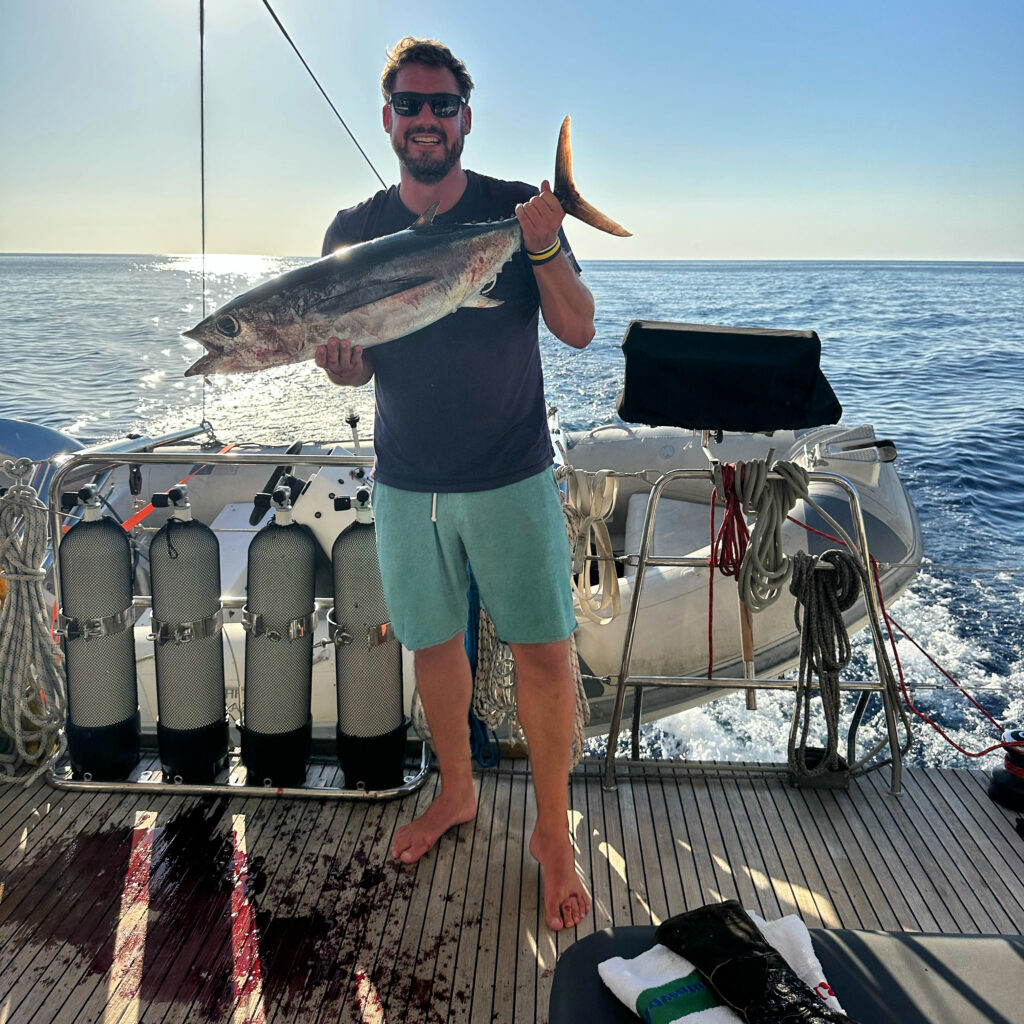
The trolling line goes out the moment we leave an anchorage on a passage. A heavy mono line on a simple reel, clipped to a cleat at the stern, trailing a lure at about seven knots. We use different lures for different conditions: skirted lures in blue water for pelagic fish, smaller metal lures closer to the reef edges. The line goes out and we forget about it until something hits it.
Something hitting the line has a specific sound and feel. The reel screams. The line goes tight. If it is a serious fish, the whole stern of the boat vibrates with it. My father taught me to read what is on the line before it surfaces from the way it fights: a dorado runs and jumps, a tuna runs deep and heavy and steady, a wahoo takes line so fast the first thirty seconds feel like the line has caught something fixed in the water. You get it wrong sometimes. You know quickly.
The landing is a two-person job. One person keeps the line, the other has the gaff or the net. A large yellowfin on a hand line is not a gentle activity. My father is very calm during this process. I was not calm during this process for many years and then gradually became calm and now I understand what he was doing. The fish is going to come in when it is ready. Rushing it loses the fish.
The Filleting
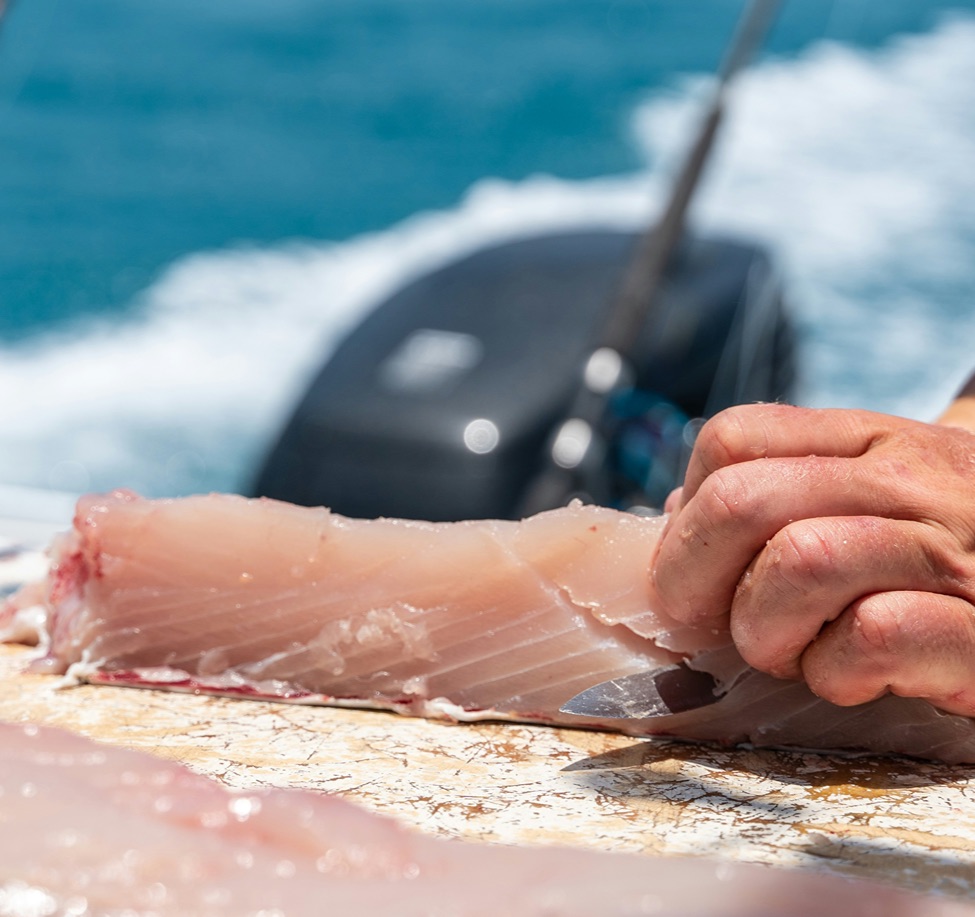
The fish goes on the cutting board on the afterdeck. The knife has to be sharp, which means the knife is always sharp because a blunt knife on a rolling boat is genuinely dangerous. My father filleted fish in front of me probably a hundred times before I was allowed to do it myself, and I watched every time because the technique is specific and the result, if you do it correctly, is two clean fillets with almost nothing wasted.
Mahi-mahi is forgiving and fast to fillet: the flesh is firm and the bone structure is simple. Yellowfin tuna requires more precision and a longer knife because of the size. Wahoo is the most beautiful to fillet: the flesh is white and dense and when you open it up properly it looks like something from a Japanese fish market rather than something that was swimming in the ocean forty minutes ago.
We fillet over the side. The frames and the offal go back into the water, where they are eaten within minutes. Nothing is wasted because the ocean takes care of the rest. What stays on the cutting board is the fish, clean and fresh and ready, and the question of what to do with it.
The Sushi
Sushi from a fish that was alive in the ocean forty-five minutes ago is not the same as sushi from a restaurant. I am not being precious about this. It is simply a different product. The texture of the flesh has not changed under refrigeration. The flavour has not dulled. The colour of yellowfin tuna cut from a fish that has not been on ice is a red so deep it is almost purple, and when you taste it there is nothing between you and what the fish was.
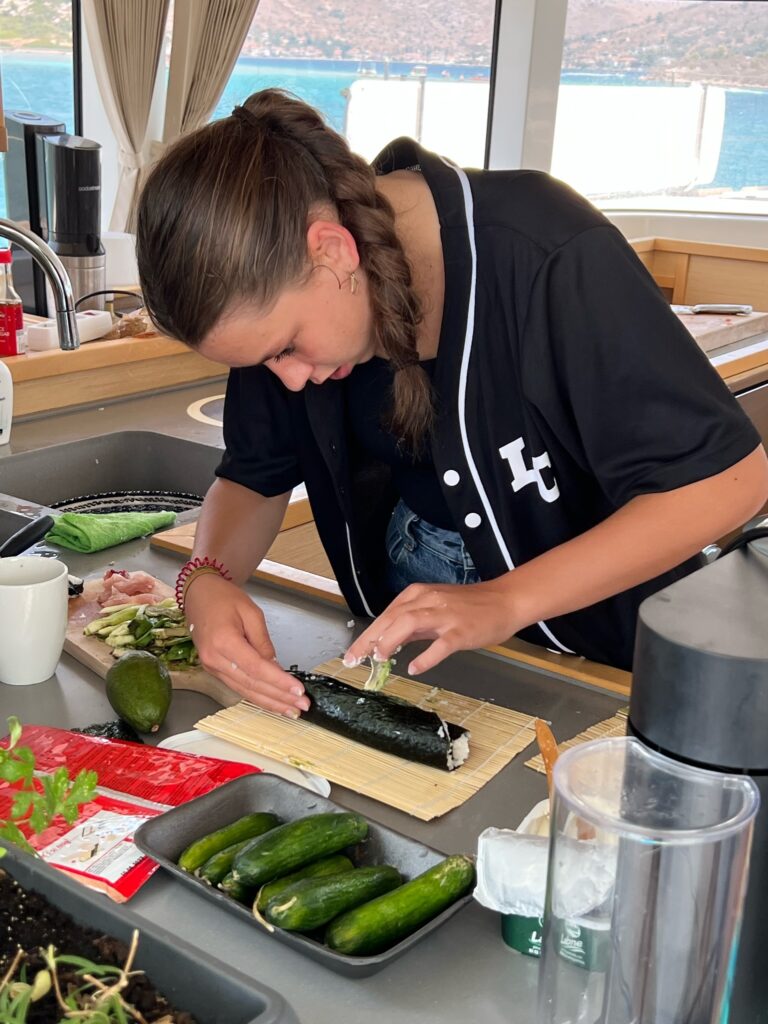
We make sushi when we catch a good tuna on a passage day, which is our version of a celebration meal. The rice has to be already cooked, which means anticipating the catch, which we do because the trolling line is always out and tuna are always a possibility in blue water between ten and twenty degrees of latitude. We keep sushi rice and nori and wasabi aboard as permanent pantry items. The soy sauce comes from the last port. The ginger comes from the herb garden or from what we bought at the last market.
The preparation happens on the afterdeck in the afternoon, after the fishing and the filleting and the rice. My father slices. I roll. Members assemble. The result is eaten immediately, while the fish is at its most alive in the flavour, with the ocean around the boat and the satisfaction of knowing exactly where every element came from and how recently it was alive.
There is no restaurant in the world that can replicate the context of that meal. The fish is too fresh, the setting is too specific, and the process that produced it is too direct. You caught it. You cleaned it. You ate it. The whole chain from ocean to plate took less than two hours. That is the meal.
The Herb Garden
My parents have grown herbs on deck for as long as I can remember. Not as a project or a lifestyle statement, but because he cooks and herbs are necessary and buying dried herbs in every port is an inferior solution. The planters are simple and purpose-built for the marine environment: deep enough for the roots, secured well enough to survive a passage without migrating, with drainage that prevents waterlogging and death by overwatering in the tropics.
The standard complement is basil, thyme, rosemary, flat-leaf parsley, chives, and coriander. In the Mediterranean, the rosemary and thyme thrive because the climate suits them and the salt air apparently agrees with them. In the tropics, the basil goes extraordinary: warm nights and tropical sun produce plants that are larger and more fragrant than anything grown in a pot on a northern European windowsill. The coriander bolts in heat and requires succession planting, which means that every time we are in a port with a decent plant market, we buy new coriander seedlings and replace the ones that have gone to seed.
The herbs change everything about the cooking. A grilled fish with basil from the deck tastes different to the same fish without it, not because the basil is spectacular, but because it is fresh, picked minutes before serving, still carrying the volatile oils that dried herbs have lost entirely. The thyme that goes into a stock has been growing six feet from the galley. The coriander on the Thai-inspired fish curry came off a plant that was in the water off Phuket when the fish in the curry was still alive. There is a circularity to it that I find satisfying in a way that is difficult to explain.
Local Produce: Not the Supermarket
The vegetables and fruit aboard, in the years before the chef and also now, come from local growers and local markets rather than from supermarkets. This is a principle my father instilled early and that I have never found a reason to question. The tomato from the woman at the Bodrum dock who grew it in her garden behind the house is a different object to the tomato in the plastic tray at the chandlery supermarket.
The mango from the boy on the pirogue in Nuku Hiva who collected it from his family’s garden that morning is a different mango to any mango available in Europe. The papaya in the Marquesas that has been allowed to ripen on the tree instead of being picked green for shipping is the reason that Europeans who encounter it for the first time often cannot believe it is the same fruit.
We provision at markets whenever possible and directly from producers whenever the opportunity exists. In Turkish bays in the early season, farmers bring produce to the anchorage by dinghy: tomatoes and courgettes and aubergines that were in the ground that morning. In Fiji, the village women sell root vegetables and greens and fruit from their gardens for amounts so small that paying them feels inadequate for what you receive. In the Maldives, the outer island families sell papaya and breadfruit and coconuts in quantities calibrated to a boat rather than a supply chain.
The best meal I have ever eaten on a boat, including all the years with the chef, was one I made myself. We had caught a large mahi-mahi two hours before arriving in an anchorage in the Tuamotu. A woman from the village on the motu paddled out to the boat and sold us a bag of limes and a bunch of coriander from her garden and some coconuts she had gathered that morning. The herbs on deck contributed basil and chives. I made a ceviche. The fish was forty-five minutes from the ocean. The limes and coriander were from a garden I could see from the afterdeck. The coconut cream came from the coconuts she had carried across in her pirogue.
There were four of us on the boat. We ate it in the cockpit as the sun went down over the atoll and nobody said very much because there was not much that needed to be said. It was perfect. And the only reason it was perfect was that everything in it came from exactly where we were, in exactly the right moment.
What the Chef Changed, and What He Did Not
When Naora became what it is now, with a dedicated professional chef aboard, the cooking changed in the ways that a professional changes anything. The technique is more consistent. The complexity of the evening meals is greater. The timing of three meals a day for twelve people is managed with a precision that I, cooking for three, never had to develop.
What did not change is the source material. The trolling line still goes out on every passage. The filleting still happens on the afterdeck. The herbs still grow on deck. The provisioning still happens at local markets rather than from supply chains. The chef works with the same ingredients I was working with in those earlier years, and he does things with them that I could not have done, and the result is something that would not be possible without either the ingredients or the skill.
But I still make the sushi when we catch a good tuna. That one I kept for myself.