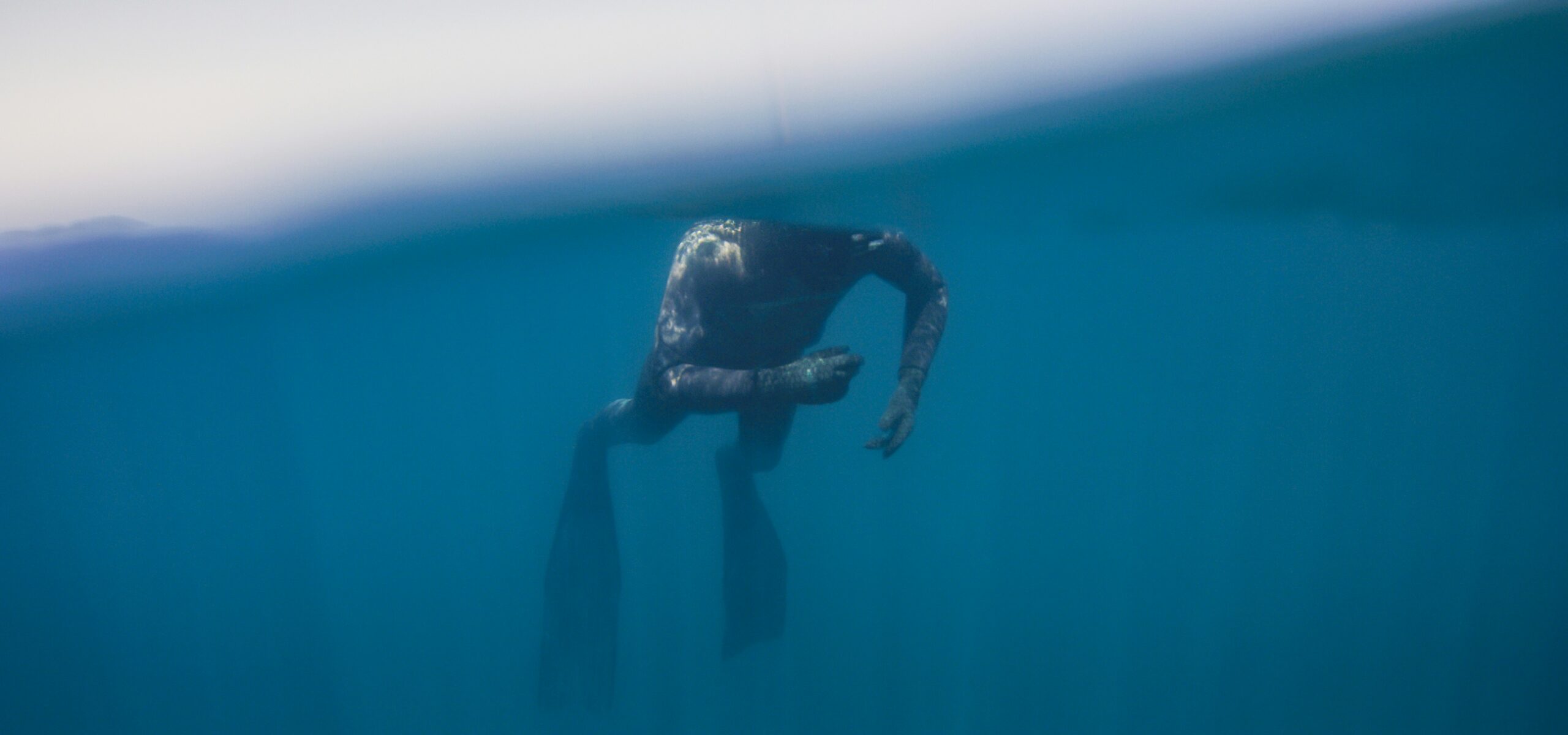
I learned to freedive properly in the Tuamotu. Not the way most people learn, in a pool with a certified instructor and a structured course. I learned because I was on the boat in the Tuamotu and the outer walls of the atolls were there, and the water was clear enough to see sixty metres down, and I wanted to go deeper than my snorkel was taking me and my father showed me the technique that the local divers used.
The technique is not complicated. You breathe slowly and completely for a few minutes at the surface until your CO2 is low and your oxygenation is high. You take a final breath. You duck-dive, exhaling slightly to equalise your buoyancy and descend without effort. At a certain depth, the water pressure compresses your lungs enough that you become neutrally buoyant and the descent requires no fin work at all. You glide. The wall is beside you. The blue is below. The surface is above, increasingly distant, and for the duration of that descent everything else is very far away.
Why Freediving Is Different to Scuba
My father is a CMAS-certified diving instructor with thousands of dives across both disciplines, and he will tell you that freediving and scuba are different activities that happen in the same water. Scuba is exploration: you have time, you can hover, you can investigate, you can stay. Freediving is presence: you have perhaps sixty to ninety seconds, nothing is passive, every second of the dive is the dive, and the ascent at the end is a return rather than a withdrawal.
What freediving produces that scuba does not is silence. There are no bubbles. There is no regulator sound. There is no equipment noise of any kind. There is the water around you and the wall beside you and the specific quality of attention that a single held breath creates: completely focused on the present moment because the present moment is finite and specific in a way that an hour on scuba is not. The fish do not react to you the way they react to a scuba diver. You are quieter. You belong, briefly, to the water in a different way.
The Best Sites on the Naora Route
The Tuamotu outer walls in French Polynesia are the finest freediving I have done anywhere. The visibility is 40 to 60 metres in most conditions, the wall drops from the surface to several hundred metres, and the current that sweeps along the outer face of the atoll brings pelagic life: grey reef sharks cruising the wall at 15 metres, schools of barracuda spiralling above the drop-off, the occasional Napoleon wrasse moving along the coral with the unhurried confidence of something that has no predators within its range.
The Maldives outer atolls are the other location I return to most often in my mind when I think about freediving. The water is warm and exceptionally clear, the outer walls are vertical and deep, and the mantas that clean at the atoll mouths will allow a freediver to approach much closer than a scuba diver because of the silence. I have been within two metres of a manta ray on a freedive, hovering beside the cleaning station at eight metres depth, watching it circle while the cleaner fish worked. It was one of those minutes that a single held breath contained completely.
The Red Sea, particularly the outer walls at Brothers Islands and Elphinstone, offers freediving that my father considers among the best available anywhere on the route. The coral cover on these outer walls is extraordinary. The pelagic life at the drop-offs includes oceanic whitetip sharks that behave very differently toward a freediver than toward a scuba diver: curious rather than alert, approaching to investigate before moving on. This is not a situation for inexperienced freedivers. It is a situation for people who are comfortable in the water with large sharks and who understand the behaviour well enough to read it correctly. My father is present for these dives.
For Members Who Want to Begin
You do not need to be an experienced freediver to start. The technique is accessible to anyone who is comfortable in the water, and the shallow reef gardens in most of our anchorages provide a completely safe environment for the first steps: four or five metres of depth, calm water, no current, and as much time as you need to practice the breath-up and the duck-dive and the first experience of descending under your own breath.
The crew aboard teaches the basic technique to any member who wants to learn. Not as a formal course, but as the same informal instruction he gave me on the Tuamotu when I was a teenager and the outer wall was there and the only thing between me and going deeper was the knowledge of how. The knowledge is simple. The practice is its own reward.
And once you have been down the outside of an atoll wall on a single breath with the blue below you and the coral beside you and nothing between you and the surface except the length of your own held breath, you understand what I have been trying to describe in this article in a way that no description quite achieves.