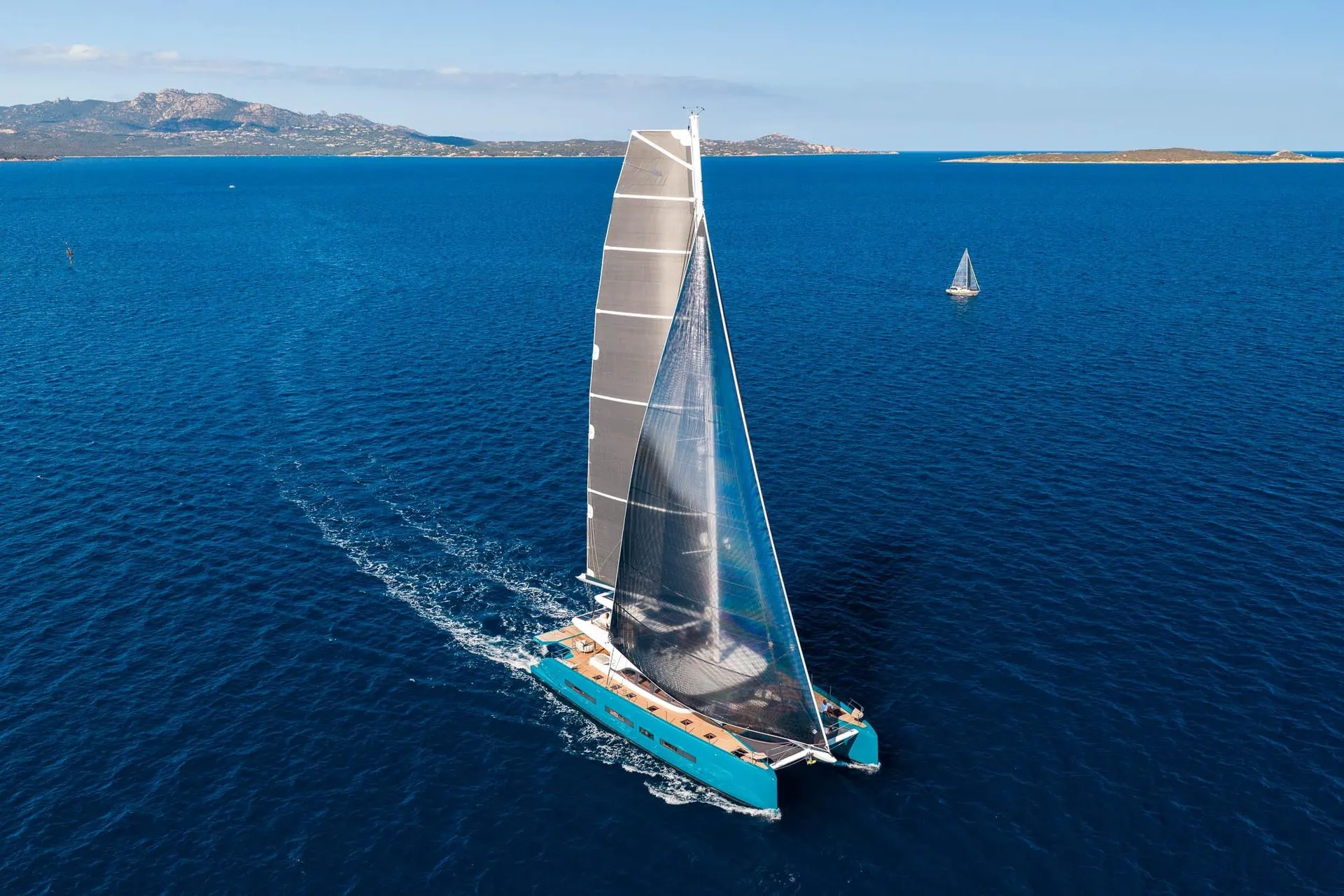
The choice of vessel for a five-year circumnavigation is not a preference. It is a decision with consequences that play out across every passage, every anchorage, every night at sea, and every meal at the table. We spent a long time making it carefully, and the Lagoon Eighty2 is the answer we arrived at. This article explains why, and what that choice means in practice for everyone aboard.
The Numbers, and What They Mean
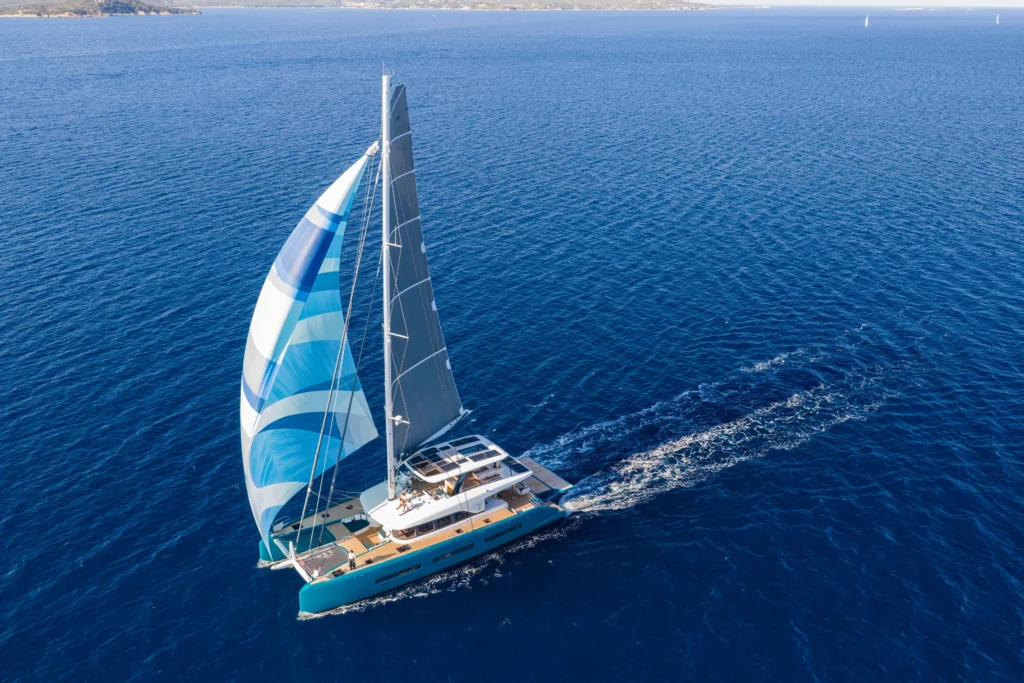
The Eighty2 is 23.98 metres long, with an 11.09-metre beam, a displacement of 66 tonnes, and a sail area of 340 square metres split between a 200-square-metre mainsail and a 140-square-metre genoa. It carries six to seven private double cabins with en-suite bathrooms, depending on configuration. It is powered by twin 175-horsepower diesel engines for port manoeuvring and windless passages.
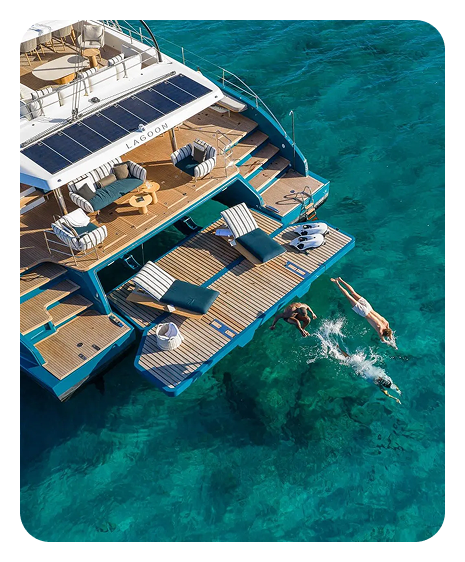
These numbers tell part of the story. What they do not convey is the quality of the space those numbers produce. A catamaran of this size has approximately two to three times the living area of a monohull of equivalent length. The two hulls provide private cabin accommodation that does not share walls with a neighbour’s sleep cycle. The wide beam creates deck space that feels generous rather than functional: a place to live on rather than to move across carefully. The salon is large enough for everyone aboard to be in it at the same time without anyone feeling crowded.
At 66 tonnes, the Eighty2 is built for ocean passages rather than coastal day trips. It does not flex in a seaway. It does not accelerate suddenly in a gust and leave the person below with a bruise from an unexpected encounter with a hatch. It moves through the water with the confidence of something purpose-built for the long distance, which is exactly what it is.
Why a Catamaran and Not a Monohull
The catamaran versus monohull question is one that serious sailors argue about at length, and both sides have legitimate points. We have made our choice, and we are clear about the reasons.
For a vessel designed to carry ten to twelve members on passages of weeks rather than days, in comfort rather than in endurance mode, the catamaran is the correct answer. The monohull heels. It tips to one side in a breeze and stays there, which means the cabin sole is at an angle, the table requires a fiddle to keep things from sliding off it, and the person who is not on watch is either braced against a bulkhead or wedged into a bunk with a lee cloth. This is sailing. It is also not the context in which anyone does their best thinking, sleeps their most restorative sleep, or eats a meal that deserves to be called a meal.
The Eighty2 stays level. In trade wind conditions, with the wind in the aft quarter and the boat running downwind, the motion is a comfortable, rhythmic pitch that most people find easy to adapt to within a day. At anchor, the boat is essentially stationary: a stable platform that happens to be floating. The cook can prepare a proper meal. The member who wants to read can sit on the afterdeck without holding on. The person in the salon can set their coffee cup down and find it in the same place when they return.
This is not a minor comfort consideration. It is the difference between a way of living at sea that is genuinely sustainable over weeks and months, and one that is impressive for a few days and wearing thereafter.
A Note on Propulsion
We sail whenever we can. The Eighty2’s sail area of 340 square metres is powerful and efficient offshore, and on the trade wind passages that form the backbone of the five-year route, the engines are largely irrelevant. We move on wind.
When the engine is needed, it is there: twin 175-horsepower diesel engines designed for port manoeuvring, windless passages through the doldrums, and the safety margin that a serious offshore vessel requires. We are aware of our environment. We sail from anchorage to anchorage and use the wind wherever it is available. But the engine, when needed, is for safety. And on that, we make no compromises. Electric propulsion technology has not yet reached the point where it can reliably support the demands of a continuous global expedition. Diesel is not our preference. It is our responsibility.
The Living Spaces
The Eighty2 is not designed to look impressive in a marina. It is designed to be lived in at sea. There is a distinction, and it matters on a five-year voyage.
The private cabins are genuinely private. Each has its own en-suite bathroom, its own storage, and its own access that does not require passing through a shared space to enter or exit. On a boat with ten to twelve people aboard, privacy of this quality is not a luxury. It is a prerequisite for the kind of community that actually works over weeks and months.
The salon is the communal centre of the boat: a large, light-filled space with a dining table, seating, and a navigation station that keeps the operational side of the vessel visible without dominating the living space. The galley is adjacent, which means the chef is part of the social environment rather than isolated from it. Meals are prepared in a space where conversation flows naturally between cook and company.
The afterdeck and the flybridge are where most of the day is actually lived. The afterdeck at the stern of the boat is the primary outdoor social space: large enough for the whole group, with seating that looks out over the water in every direction. The flybridge above it offers an elevated position with the fullest possible view: the horizon in every direction, the sails above, and the wake stretching behind. On passage days and on anchor evenings, these are the spaces that hold the community.
The Eighty2 by the Numbers
| Specification | Detail | Why it matters |
|---|---|---|
| Length overall | 23.98 metres | One of the largest production catamarans in the world; scale supports genuine offshore self-sufficiency |
| Beam | 11.09 metres | Exceptional deck space and the stability platform that makes catamaran living possible at sea |
| Displacement | 66 tonnes | Built for ocean passages, not coastal day trips; moves through a seaway with confidence |
| Sail area | 340 square metres | Mainsail 200m2 plus genoa 140m2: powerful and efficient on the trade wind routes that define the circumnavigation |
| Private cabins | 6 to 7 double cabins with en-suite bathrooms | Genuine privacy for every member; the prerequisite for a community that works over weeks and months |
| Twin diesel engines | 2 x 175 horsepower | Reliable propulsion for port manoeuvring, windless passages, and the safety margins a serious offshore vessel requires |
Why This Vessel Makes the Journey Possible
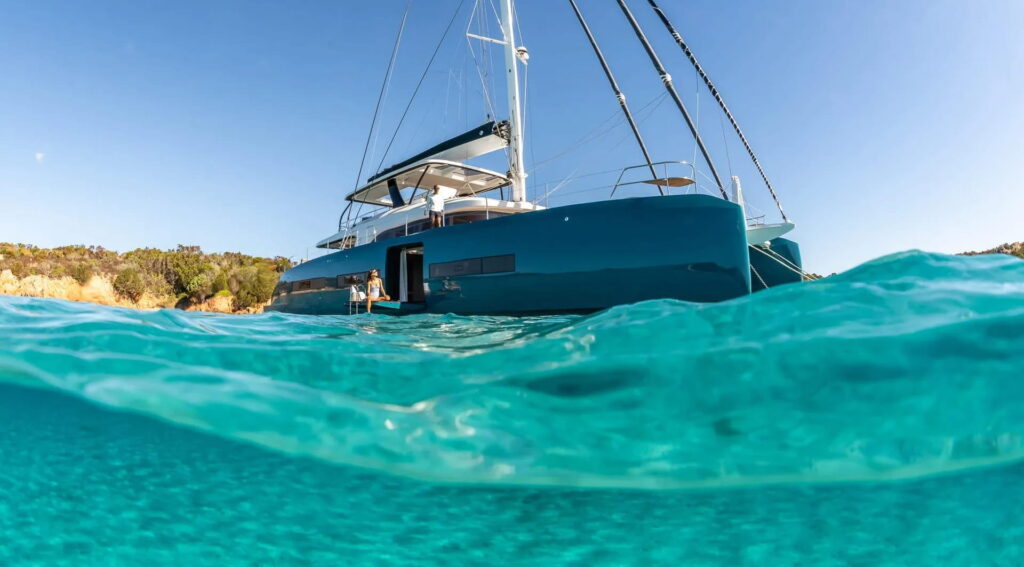
The vessel is not the experience. But it is the platform on which the experience becomes possible, and the quality of that platform determines what kind of experience is available.
A smaller boat with less stability would make the trade wind crossings less comfortable and the community dynamic more compressed. A charter vessel with shared bathrooms and no dedicated crew would change the texture of daily life in ways that compound over weeks. A monohull would heel, and the meals and the sleep and the reading and the conversation would all be conducted at an angle.
The Eighty2 does not compromise on any of these things. It provides genuine space, genuine privacy, genuine stability, and the self-sufficiency, the watermaker, the diving compressor, the sail area, the fuel range, that makes the remote anchorages and the long ocean crossings genuinely accessible rather than merely theoretically possible.
It is, in the most specific sense, the correct vessel for this journey. Not the most expensive option, not the most ostentatious, but the one that has been thought through against the actual demands of a five-year circumnavigation with a community of ten to twelve people living aboard. The catamaran is not a compromise. It is the answer.