It is the question we hear most often from people who are seriously considering Naora but have never sailed before. Sometimes it is asked directly. Sometimes it arrives sideways, as a question about the boat’s motion or the length of the passages or what happens if someone feels unwell offshore. The question underneath all of them is the same: will I be able to handle this?
The honest answer is reassuring. But it is not a blanket guarantee, and we would rather give you the real picture than tell you what you want to hear.
Why the Lagoon Eighty2 Is Different
The single most important factor in seasickness is the motion of the vessel. And on this point, the choice of a catamaran over a monohull makes a significant and measurable difference.
A monohull sailing yacht heels. In a breeze, it tips to one side and stays there, sometimes at angles of 20 to 30 degrees, while the waves push it through a rolling, pitching motion that the inner ear finds genuinely difficult to process. This is the motion that most people associate with sailing, and it is the motion most responsible for the seasickness that puts people off it.
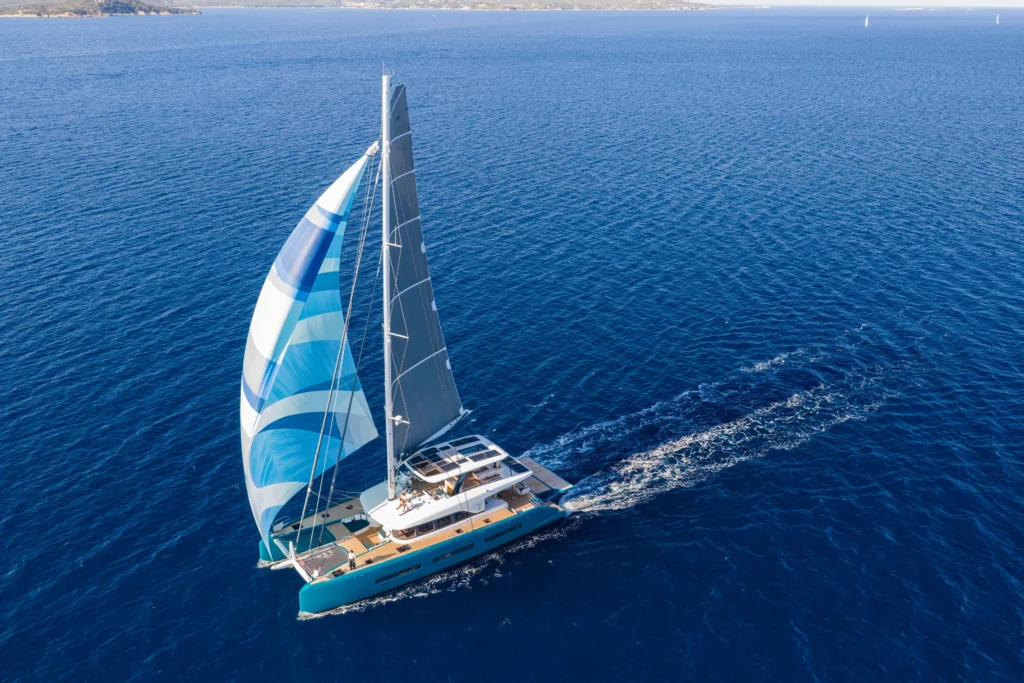
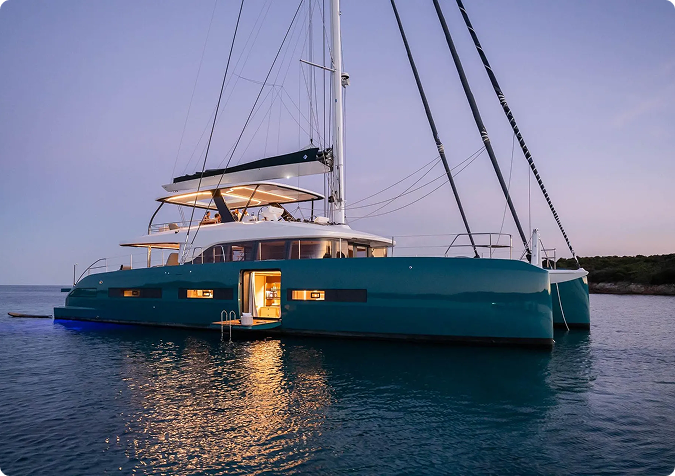
A catamaran does not heel in the same way. The Lagoon Eighty2 has an 11-metre beam and two separate hulls. That width creates a stability platform that is fundamentally different in character to a monohull of equivalent or even significantly larger length. The boat stays level. It moves through the water in a different axis: a gentle pitching motion rather than the rolling, tilting movement of a single-keeled vessel. For most people, this motion is far easier to tolerate, and many who have been seasick on monohull sailing boats find that they are entirely comfortable on a catamaran in conditions that would have laid them flat before.
This is not a small distinction. It is one of the primary reasons we sail a catamaran rather than a monohull, and it directly affects the comfort of every person aboard on every passage.
What Actually Causes Seasickness
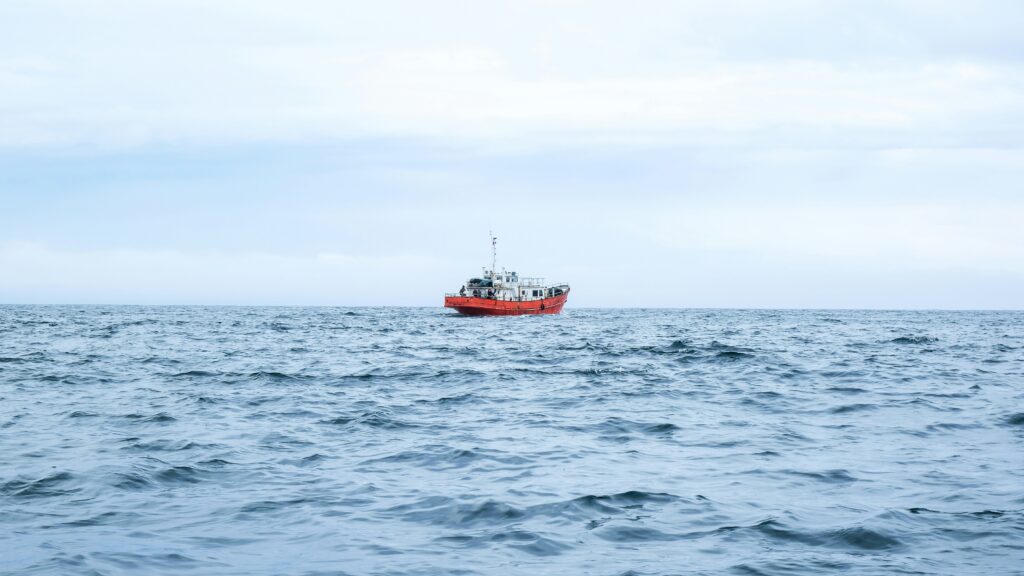
Seasickness is a conflict between what the inner ear senses and what the eyes see. When the body is moving in ways the eyes cannot verify, the brain interprets the discrepancy as possible poisoning and responds by trying to empty the stomach. It is an entirely normal physiological response, not a weakness and not a failing. Some people are more susceptible than others for reasons that are partly genetic and partly experiential, and almost everyone is susceptible under sufficiently extreme conditions.
The conditions that produce it most reliably are: below decks on a moving vessel, especially reading or looking at screens; in choppy, confused seas with irregular motion rather than the steady rhythm of a trade wind swell; and in the first one to two days of a passage, before the body has adapted to the movement. All three of these factors can be managed.
Being on deck, with the horizon visible, is the single most effective thing a person can do to prevent motion sickness on a boat. The eyes and the inner ear agree about what is happening, and the conflict resolves. On the Eighty2, the afterdeck and the flybridge are large, comfortable spaces with wide visibility. On passage days, members who are managing motion sensitivity are encouraged to be outside rather than below, and the boat is arranged to make that easy.
What We Carry and What We Recommend
We carry seasickness remedies aboard as standard. Antihistamine-based tablets, scopolamine patches, and acupressure wristbands are all available. If you know you are prone to motion sensitivity, the conversation to have with us is before you board, not after you feel unwell, so that we can make sure the right options are available and positioned for the first passage days.
We also recommend, for anyone who has concerns, consulting a travel health clinic or GP before departure. Some prescription options are significantly more effective than over-the-counter remedies and worth discussing in advance. Six to eight weeks before your voyage is a reasonable lead time for this conversation.
What Most People Actually Experience
The majority of Naora members find their sea legs within the first day or two, often sooner. The gentle rhythm of the Eighty2 at anchor is genuinely soothing: a barely perceptible movement that most people describe as comfortable within hours of arriving. On passage, the motion takes a little longer to adapt to, but the catamaran’s stability means that adaptation is faster and less uncomfortable than on a monohull.
A small minority of members experience genuine discomfort in the first 24 to 48 hours of a longer passage, particularly in confused seas or choppy conditions. This is normal, it passes, and it is managed with the remedies we carry and the practical strategies the crew can offer: fresh air, the horizon, light food, and staying in the forward part of the boat where motion is least pronounced.
We have not had a member who could not continue a voyage because of seasickness. What we have had is members who were uncomfortable for a day and fine for the rest of the passage, and who arrived at the destination with a specific kind of satisfaction that only comes from having moved through something that was briefly difficult.
| Factor | How we manage it |
|---|---|
| Vessel motion | The Eighty2 catamaran is inherently more stable than a monohull: minimal heel, predictable pitch, wide platform |
| Below-decks sensitivity | Large afterdeck and flybridge provide comfortable outdoor space with full horizon visibility on all passages |
| First 48 hours | We time longer passages when possible to begin in calm conditions, and brief members on the adaptation process before departure |
| Existing sensitivity | We carry antihistamine tablets, scopolamine patches, and acupressure bands; prescription options discussed pre-voyage |
| Irregular sea state | Routing avoids the worst cross-swell conditions where possible; passage timing accounts for weather windows |
The Conversation to Have Before You Board
If motion sensitivity is a genuine concern for you, tell us before you board. Not because it changes whether you can join, but because it changes how we prepare. We can position remedies in your cabin. We can brief you on the specific strategies that work best on the Eighty2. We can be aware of it on the first passage day and check in without you needing to ask.
Health is personal, and at Naora we treat it that way. Everything you share with us before boarding is handled with complete discretion and used only to ensure that your experience is as good as it can be. The more we know, the better we serve you. That applies to seasickness as much as it applies to anything else.