I would leave the first lagoon morning unassigned. If private yacht hire in French Polynesia is meant to recognise exceptional work, putting a snorkelling departure into everyone’s calendar before anyone has slept aboard feels like the wrong beginning. There should be breakfast, an account of the conditions and something worth choosing. There should also be a comfortable way to choose nothing.
The difficulty is that recognition arrives with a relationship attached. Someone has offered this time, perhaps someone who also decides responsibilities and promotions at work. A person can understand perfectly that swimming is optional and still feel that remaining aboard would be ungracious. I want the design of the voyage to address that pressure before it reaches the bathing ladder. Saying that people are free is easy. Making their freedom usable takes more thought.
Planning Private Yacht Hire In French Polynesia
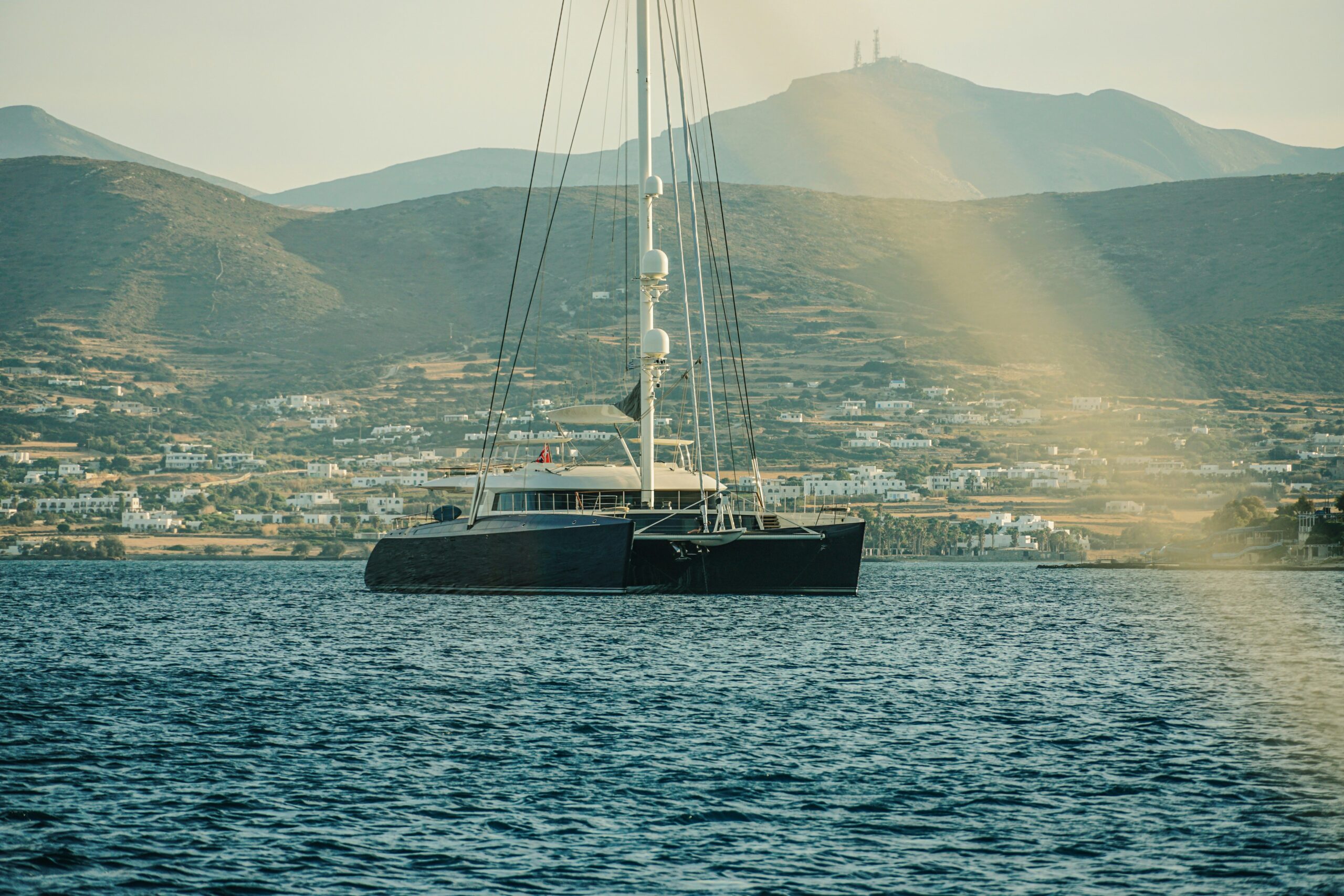
Discovery, the Lagoon Eighty2 sailing catamaran that will carry the Naora Global Expedition, can be privately hired for a carefully designed voyage along the real route. French Polynesia belongs to that continuing expedition, planned for 2027 to 2031. A private party joins part of a much longer undertaking; the yacht does not become detached from the seasons, passage requirements and onward responsibilities that make the whole route possible.
For recognition, I would begin with the character of the time aboard rather than a list of activities. Someone may welcome open-water sailing but dislike organised outings. Another person may love swimming yet find motion exhausting. Those are different planning needs, and neither can be understood from a record of professional achievement. Being exceptionally capable at work tells us very little about how someone wants to spend a morning at sea.
The proposed leg needs to be described plainly: how much moving between places it involves, where joining and leaving are practical, and how much flexibility weather may require. An atoll lagoon can offer shelter from ocean swell without providing a motionless anchorage. A passage between lagoons is still a sea passage. I would rather someone decide against a particular voyage with accurate information than discover aboard that the quiet week they imagined includes sailing they had never wanted.
Across much of central French Polynesia, May to October is generally the drier season. That is useful context, not a promise of calm water. Trade winds can remain vigorous, and squalls still require attention. The season helps shape the route; the forecast, observed conditions and the vessel’s circumstances shape the day’s decision. A company calendar cannot settle those questions in advance.
Recognition Without An Obligation To Join In
The most consequential choices may happen before anyone travels. Does the person actually want time away with colleagues? Would the presence of a senior leader make the experience warmer, or turn every breakfast into an occasion to be attentive? I would ask those questions privately, while a different answer can still change the plan. Asking in front of the group is often a way of obtaining agreement rather than discovering a preference.
There is a practical distinction between collecting information and collecting explanations. The crew needs to understand relevant health considerations, mobility, swimming confidence and food requirements. The organiser does not need a personal account of why someone would rather read than snorkel. I would make that boundary clear. Safety information should reach the people responsible for safety; a preference for solitude need not become part of an account of someone’s personality.
Work also needs somewhere else to go. An afternoon without meetings is of limited use if the person remains responsible for every decision arriving from shore. Before departure, responsibilities can be handed over, urgent matters defined and colleagues told what response to expect. Connectivity along a sailing route cannot be guaranteed. Even when a connection is available, its presence should not silently reopen the working day.
Nor would I replace work with an expectation to demonstrate recovery. Sleeping late, making a necessary call and spending an hour looking at the water are not competing performances of having understood the gift. Someone may remain restless for several days. Someone else may enjoy company throughout. Appreciation should survive both responses without the host needing reassurance that the voyage was a good idea.
Reading A Lagoon Before Choosing An Activity
A lagoon’s colour is persuasive. It is much less informative than it first appears. Pale water may indicate shallow sand, but glare, cloud shadows and coral can complicate what the eye is seeing. Behind a reef, the absence of long ocean swell can disguise the effect of wind blowing across a substantial stretch of open water. A Force 4 breeze, 11 to 16 knots, can produce enough short chop to make a tender ride wet and a ladder awkward. The same wind may feel agreeable from a shaded seat.
At an atoll pass, water movement deserves particular respect. Tide is only part of the explanation. Waves breaking over the surrounding reef can feed water into the lagoon, which then needs a way out; wind and the shape of the entrances also influence the flow. The time of high water is therefore not a reliable appointment for slack water. A tide prediction helps inform the assessment, but it cannot replace local information and observation at the pass.
This matters even to someone who has no intention of entering the water. A departure may be moved to meet a safer transit window. An anchorage may be rejected because the light is poor for identifying coral heads. Low sun ahead can turn the surface into a sheet of reflected light just when the crew needs to distinguish depth and obstruction. I would want that decision explained without turning it into drama. The useful information is what has changed and what the alternative will be.
Anchoring is another choice hidden beneath an apparently easy afternoon. Suitable holding ground, adequate depth through the expected water-level changes and room for the yacht to swing all matter. So does the path the chain may sweep. Finding a patch of sand is insufficient if the chain will drag across neighbouring coral as the wind shifts. Sometimes the responsible answer is a different anchorage, even if the first has the more attractive view.
Standing at the stern with a mask in your hand, you can feel ready before you have understood the water. Sun warms your shoulders; the first wet rung is cool underfoot. Yet a current of just 1 knot moves water roughly 30 metres in a minute. That arithmetic explains why clear visibility and apparent proximity to the yacht do not establish an easy return. Entry, exit, supervision and recovery need to be settled before a swimmer leaves the ladder.
I would keep a casual lagoon swim distinct from an outing involving a pass or stronger moving water. The latter needs its own assessment and appropriate support, not a more enthusiastic briefing. Nobody should be persuaded into the water by the confidence of a colleague. A mask that leaks, unfamiliar fins or discomfort with depth is reason enough to stop. The person who stays aboard has made a choice, not failed a test.
Quiet Time Needs A Practical Plan
Freedom aboard cannot mean an unlimited number of simultaneous requests. A tender taking people ashore cannot also be assumed to provide immediate recovery somewhere else. The crew must retain the attention and resources needed to look after the yacht and everyone aboard. If a lagoon activity would stretch those resources, reducing the programme is more responsible than asking the crew to make an overfull morning appear effortless.
I would agree on departure and return arrangements, then leave the hours within them lightly held. People need to know when the tender is leaving, what conditions would bring it back early and how changes will be communicated. They do not need every interval filled. Someone remaining aboard still needs to be accounted for, just as someone ashore must understand the return arrangement. Freedom from sociability does not remove the ordinary responsibilities of living together on a vessel.
Quiet also has an acoustic reality. A call on speaker can occupy a shared space more completely than a conversation among several people. A camera lifted without warning can make someone suddenly conscious of being observed. I would agree on simple expectations before these become irritations: calls kept out of shared quiet space, photographs taken with consent, and no assumption that a company may publish an image because it arranged the voyage.
Ashore, private time remains time in somebody else’s home. An apparently empty stretch of land is not automatically open to visitors. Access should be established, local restrictions respected and purchases made with attention to what is actually available. In the water, wildlife should not be fed or pursued to manufacture an encounter. An appreciation voyage does not need a sequence of remarkable events to justify itself. Sometimes the appropriate activity is to look carefully and leave little disturbance.
Shared Meals Without A Ceremony
I would keep the main shared meal as an offered point of return. Too little structure can leave people wondering where they should be, and that uncertainty can be more tiring than a modest plan. Knowing when food will be ready allows someone to swim, rest or go ashore without repeatedly checking what everyone else is doing. The table provides familiarity without requiring the afternoon to be communal.
For a settled evening aboard, I can imagine poisson cru as part of that meal: fish, lime and coconut milk, with vegetables for freshness and texture. Cutting lime releases oil from the skin onto the fingers; coconut milk softens the sharpness of the juice. The preparation rewards attention to timing. Leaving fish in acid for longer changes its texture, but it does not turn the dish into cooked fish in the food-safety sense.
Fish intended for raw service needs suitable sourcing and handling, including appropriate parasite controls. It should be kept chilled at 4°C or below, prepared close to serving and returned to refrigeration if service is delayed. Freshly caught is not, by itself, a safety standard. Lime does not reliably eliminate pathogens or parasites. In tropical waters, certain reef fish can also carry ciguatoxins, which cooking and freezing do not destroy. Species and local knowledge matter before the knife ever touches the board.
That is why I would allow the menu to change with the ingredients that can responsibly be obtained. A local dish should not become a demand placed on a supplier regardless of the day’s catch or the condition of the produce. Something cooked well from dependable provisions is preferable to a raw preparation chosen for its appearance in a photograph. The same judgement applies to timing: a meal under way needs a different arrangement from dinner at a settled anchorage, with hot dishes and loose objects kept secure against movement.
At the table, I would avoid turning thanks into a surprise event. Recognition can be direct and specific beforehand: the work noticed, the responsibility carried, the reason it mattered. There is no need to conceal those words inside a speech that requires a response in front of colleagues. Conversation over dinner can then find its own subject. The fish does not need to arrive with a lesson about teamwork, and someone leaving the table early does not need to apologise for the meal being good.
The Limits Of Private Yacht Hire
There is a credible argument for more structure than I instinctively prefer. Some people find an entirely open day uncomfortable, particularly in unfamiliar surroundings. They want to know what is possible, what clothing or equipment is needed and whether choosing an activity will inconvenience anyone. A clear suggestion can feel like care. The mistake is to confuse offering direction with seeking participation from everybody.
A short briefing the evening before can make the distinction practical. It can explain the intended movement of the yacht, the weather considerations, any likely opportunity to go ashore or enter the water, and the decisions still awaiting morning conditions. I would present a genuine alternative alongside any proposed outing. Remaining aboard should not be described as what happens to those who do not join the interesting part. It is part of the plan and needs to work just as well.
Private hire makes it possible to shape this rhythm around one group, but it cannot eliminate the proximity of other people or the limits of a moving vessel. It cannot guarantee uninterrupted sleep, complete disconnection or a particular emotional response. For someone who needs to be able to leave independently at any moment, a voyage may be the wrong form of recognition. That possibility belongs in the decision, not in the small print of the experience.
Leaving The Appreciation With The Person
The restraint needs to continue after the voyage. I would not ask for a public account of what it meant, a photograph to illustrate gratitude or a reflection that could be turned into an internal presentation. Useful feedback about arrangements is a separate matter. A person should be able to say that a tender transfer was uncomfortable or a sailing day too long without seeming to diminish the appreciation behind the offer.
There may be lively dinners. There may be a morning when several people choose the water and another when nobody does. I would rather judge the arrangement by whether those choices were genuinely possible than by how impressive the resulting story sounds. That places responsibility with the organiser, where it belongs, instead of with the person expected to enjoy what has been arranged.
The picture I keep returning to is modest: a shared meal finished, the next day’s practical details understood, and an hour that nobody needs to organise. One person stays in conversation. Another goes below with a book. Neither response completes the thank-you or repays it. The time is theirs, including the part nobody else sees.