The swim I want in the Caribbean has an unremarkable ending: a hand on a secure rail, a foot finding a submerged rung, enough strength left to climb without hurry. Swimming from a yacht asks us to arrange that ending before the first person gets wet.
The Caribbean forms part of the Naora Global Expedition, planned for 2027 to 2031. I will join selected legs rather than sail throughout, and when I think about entering the water from Discovery, our Lagoon Eighty2, I am interested in what makes that ordinary ending dependable. Clear water is an invitation to look. It is not permission to enter.
I like swimming without a destination, with time to notice what is moving beneath me. That freedom depends on boundaries established by someone who is still looking at the yacht, the weather and the people in the water.
Planning The Return Before Swimming From A Yacht
Getting back aboard contains several different tasks. There is the swim towards the yacht, the approach to the boarding point, perhaps a wait while someone else climbs out, and finally the transfer from being supported by water to supporting your own weight. A person can manage the first part comfortably and find the last part difficult. Reaching the stern is not the same as being safely aboard.
I would begin with the person likely to need the most help. Can they reach the handhold from the water? Can they put a foot on the lowest usable step without pulling most of their body upwards first? If they become tired, is there a practical way to assist them that does not depend on them suddenly finding more strength? These questions belong before entry, not after a long swim.
The place itself needs to allow this. An anchorage can be suitable for Discovery without being suitable for swimming. Holding ground and swinging room answer questions about the yacht; nearby tender traffic, an exposed boarding point or current running towards a channel answer different questions about people in the water. A convenient route ashore may be a poor place to put a swimmer.
The first person in should not be used to discover whether the current is manageable. Assessment comes from the yacht, the conditions and local understanding before entry. Once swimming begins, observations from the water can refine the decision, but they cannot replace the preparation that made entering reasonable.
Reading Caribbean Currents At The Yacht
Water clarity reveals shapes beneath the surface, not how much effort it will take to remain beside them. A current of 0.5 knot carries a passive swimmer 0.05 Nm in six minutes. That is enough separation to make a casual float into a sustained return, especially for someone whose comfortable swimming speed is modest. If their speed through the water only matches the current, effort produces no progress towards an anchored yacht.
Naturally floating weed can give a first indication of movement past the hull. It needs watching over time, rather than a glance at a single fragment. Wind pushes surface material, the yacht swings, and water immediately behind a hull may behave differently from water farther out. A sheltered pocket beside the stern can be misleading if the intended swim leaves it.
The direction the yacht faces is not a current indicator on its own. Wind acts on the structure above the water while current acts below it, and the resulting heading reflects both. Tide predictions also need interpretation. High water does not automatically mean slack current at a particular channel, and a modest tidal range does not establish that flow through a narrow opening will be modest.
Reefs add another mechanism. Waves can carry water across shallow reef areas, with that water returning through gaps and channels. The surface inside may look protected while the outlet carries a concentrated flow. Before swimming near such geography, the useful knowledge concerns where the water goes, including beyond the patch visible from the stern.
A slight current does not automatically rule out a swim. In suitable conditions, beginning against it can preserve an easier return. But that familiar rule is incomplete: the flow can change, wind can complicate the return, and a swimmer may leave the weak current beside the yacht for stronger water outside it. I would rather have a small swimming area with dependable recovery than a larger one justified by everyone being reasonably fit.
How An Anchored Yacht Moves Around A Swimmer
An anchor holds the yacht within an area; it does not fix the boarding point in space. Discovery can swing as wind and current change their relationship. The stern then travels sideways through the water, sometimes towards a swimmer who has barely moved. An anchoring bridle helps distribute loads between the bows, but it does not turn a catamaran into a stationary bathing platform.
That is why the final approach needs room. A swimmer should not be pressed into a narrow gap beside a moving hull, or encouraged to wait beneath an overhanging structure. Passing between the hulls or beneath the yacht is not a shortcut back. From water level, it is harder to judge the clearance that looks generous from the deck.
Vertical movement matters just as much. A little residual swell may barely disturb breakfast while making the lowest step rise and fall noticeably. The relevant observation is the movement at the actual exit, not the comfort of someone seated farther forward. Watching through several cycles also gives a better picture than choosing the brief moment when everything appears still.
Propulsion needs a separate, explicit arrangement. It must be secured against an unintended start, not simply left idling in neutral. Whoever controls it needs to know that swimmers are in the water, and restarting requires confirmation that everyone is clear and accounted for. A tender returning alongside introduces another moving boat and another propeller. Swimming and tender movements cannot be left to sort themselves out around the stern.
Making The Boarding Point Work From The Water
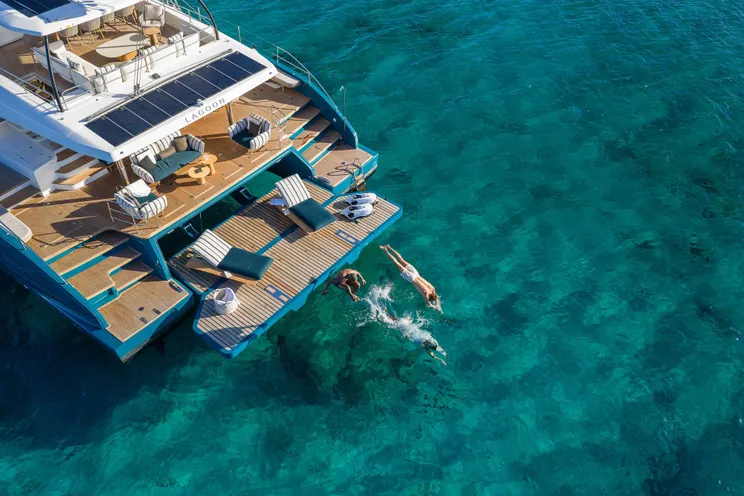
A ladder is useful only in its working position. Before entry, the boarding arrangement needs to be properly deployed and secured, with usable handholds, accessible steps and nothing loose interfering with the approach. The check includes looking for movement where there should be none: a fitting that shifts under load, a slippery tread, a line that can catch a foot. Merely seeing the ladder in place is not enough.
From the water, the body experiences this arrangement differently. A wet palm has to hold while the yacht lifts; a foot searches for a rung that may be difficult to see beneath disturbed water. As the shoulders rise out, buoyancy contributes less and the arms and legs take more weight. That transition explains why an apparently short climb can be demanding at the end of a swim.
Fins complicate the last part. They make swimming easier but can obstruct secure footing. If they need to come off before climbing, the swimmer needs support while removing them and somewhere for the fins to go. Trying to hold equipment, find a step and keep clear of a moving stern at the same time gives both hands too much work. I would rather pause with a dependable grip than hurry because someone is waiting behind me.
A waiting area matters when several people are swimming. Everyone should not converge on the same handhold together. A crew-managed line or flotation aid may help in suitable conditions, but a loose rope trailing astern is not automatically a safety system. Loops can catch legs or fins, and a line that is already beyond reach offers little assistance. Its purpose and handling need to be clear.
If the boarding arrangement cannot accommodate a particular swimmer, the answer is a different, workable recovery plan or a postponed swim. Encouragement cannot repair an unsuitable exit.
Supervision While Swimming From A Yacht
There is an important difference between people being aboard and someone watching. A person making coffee may occasionally see a swimmer. A person answering a message may believe they are keeping an eye on the water. Neither has accepted the continuous task of noticing who is present, where they are moving and whether their behaviour has changed.
A named watcher needs an unobstructed view of the swimming area and no competing task that repeatedly takes their attention away. They need to know who entered and who has returned, and swimmers need to understand an agreed recall signal. If the watcher leaves, responsibility passes explicitly to someone else. Otherwise, the swim ends. A quiet handover is much easier than discovering that everyone thought someone else was looking.
Distress may look like very little. Someone can become unusually upright, stop making useful progress or struggle to keep their mouth clear without producing a theatrical wave or shout. Knowing the swimmers and noticing a change is more useful than waiting for an unmistakable emergency. Throwable flotation and a way to summon help need to be ready, not buried beneath other equipment.
A tender only contributes to recovery if someone can operate it, communicate with the yacht and bring a tired person aboard safely. Its presence nearby does not settle those questions. Nor should the response depend on another guest impulsively jumping in. The recovery arrangement must exist before there is pressure to improvise.
Children and anyone needing close support require more than observation from the deck. Young children and non-swimmers need a designated adult within immediate reach in the water, alongside appropriate, properly fitted buoyancy support where required. That adult does not replace the watcher aboard. If the necessary attention cannot be provided, the swim does not go ahead. A confident pool swimmer may also need time to become comfortable with open water and a moving exit.
Leaving Enough Strength For The Last Metre
Across much of the Caribbean, sea surface temperatures commonly sit around 26 to 29°C, generally cooler in northern winter and warmer in summer, with local variation. That warmth removes one obvious reason to come out. It does not remove fatigue, and it can make an unhurried swim feel as though it has no natural end.
My preference would be to finish while getting out still feels easy. Waiting until the arms are tired spends the reserve needed for the approach, a short delay at the ladder or help with an awkward piece of equipment. There is no useful universal duration for this. Fitness, recent sleep, confidence, motion and the actual conditions matter more than a shared target for time in the water.
Snorkelling changes attention as well as breathing. Put your face down and the wind becomes less audible; a small fish moving over the bottom can hold your gaze while the yacht slips out of view. That absorption is much of the pleasure for me. It also makes regular looks towards the yacht important. Staying with a companion helps, but two people absorbed by the same animal can drift together.
A casual surface swim should not quietly become breath-hold diving because something interesting appears below. That needs its own plan and a competent, attentive buddy able to provide the appropriate in-water supervision. The person watching several swimmers from the deck is not a substitute.
Nor does everyone need to stay in for the same length of time. Coming out early should be an ordinary choice, not an announcement that interrupts the morning. One person may want to watch the bottom for longer; another may already want a towel. The arrangements should make either decision easy without leaving someone unsupported.
When Caribbean Conditions Mean Waiting
During the December to April trade-wind season, easterly winds around 15 to 20 knots are common in much of the eastern Caribbean, with lighter spells and stronger surges. That is regional context, not a forecast for a particular bay. A shore can shelter the yacht enough to flatten the nearby surface while wind beyond that shelter makes a drifting swimmer much harder to recover.
There is no wind speed that grants permission to swim everywhere. Direction, fetch, shelter, current and the recovery arrangement change what the same number means. A glassy patch close to land can be less forgiving than slightly rippled water with a straightforward return. I would want the decision explained through those relationships, not reduced to a reassuring instrument reading.
Northern winter can also bring swell generated by distant North Atlantic weather. Local sunshine says little about it. A swell with a twelve-second period leaves a long interval between successive crests, which can make a brief look at the stern misleading. The boarding point needs watching long enough to reveal the recurring motion and any larger sets. Passing boat wash can change an otherwise manageable exit more abruptly.
At water level, a small wave can put salt across the lips just as someone turns to breathe. Add a little fatigue and a wait beside the stern, and conditions that looked mild from above become less comfortable. These are reasons to shorten or postpone a swim before anyone is struggling. A darkening squall approaching the anchorage, increasing movement at the steps or traffic entering the swimming area can all end an earlier decision to go in.
Swimming has to fit the yacht’s wider situation. If the anchor needs attention or the weather requires a move, people come out while there is still time to do so without hurry. The assessment remains active after entry.
I look forward to the mornings when this preparation leaves very little to notice: the cool pressure of water against the face, a clear view below, a handhold exactly where it is needed. I can also accept the morning when the mask stays dry. The sea can be part of the morning without anyone having to enter it.