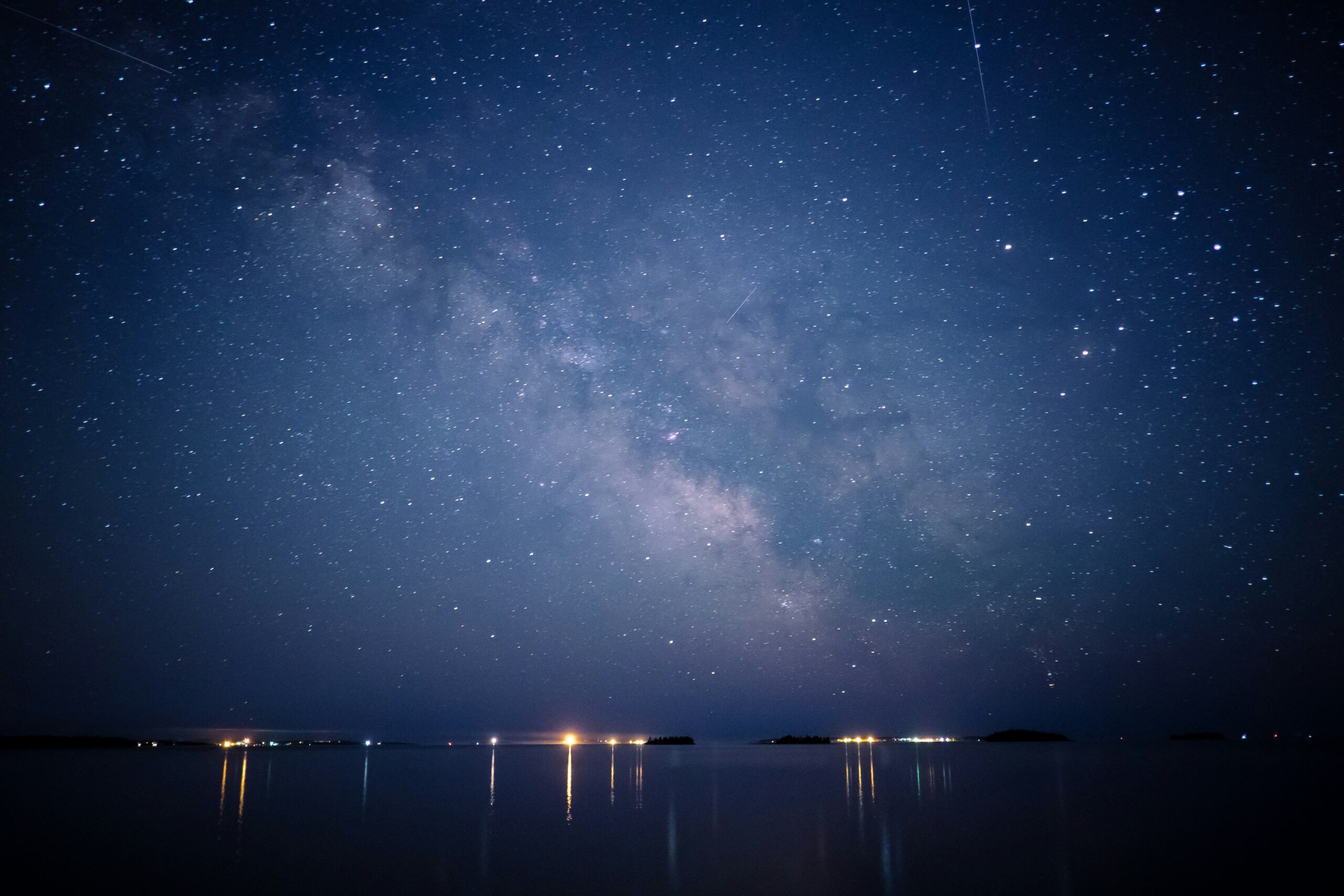
After sunset, a cabin window can show the dinner table more clearly than the water outside. For us, the connection between seabirds and light pollution begins with that ordinary reflection: light which feels contained and domestic from inside a yacht can be travelling through the glass, across the deck and out over the sea. The person sitting beneath the lamp may be the person least able to judge how conspicuous it is.
Discovery’s Pacific evenings still lie ahead on the Naora Global Expedition. As we prepare for them aboard our 2025 Lagoon Eighty2, lighting deserves the same practical attention as other things that can seem unimportant until darkness changes their consequences. We need to see where we put our feet. Other vessels need to recognise us. Neither requirement means that the surrounding water needs to become part of the living room.
The distinction matters because an illuminated yacht occupies more than its physical space. Its light can reach animals that would otherwise have no reason to approach it. There is a quiet decision to make before the evening settles: which lights have a job, where their light goes, and when that job is finished.
Seabirds And Light Pollution Near Pacific Islands
Many petrels and shearwaters return to their breeding colonies after dark, reducing their exposure to some predators. Darkness is part of the conditions in which these birds normally move between land and sea. A bright artificial source can interrupt that movement, drawing birds towards it or disrupting their orientation. Some circle repeatedly. Others collide with structures or come down on land or aboard vessels.
Young birds leaving a colony for the first time are particularly vulnerable in many affected species, but this is not only a problem of fledglings near shore. Adults can also be attracted to illuminated vessels at sea. The details vary with the species, the light, the weather and what the birds are doing. A bird approaching a yacht might be responding directly to illumination or to feeding opportunities associated with it. An approach alone does not tell us which.
It would be convenient to explain everything by saying that birds mistake a lamp for the moon. The mechanisms are less settled than that, and different responses may have different explanations. We can be confident that artificial light attracts and disorients some seabirds without pretending to know exactly what a particular bird perceives.
A yacht offers fewer illuminated surfaces than a large coastal settlement, but it also offers rigging, hard edges and deck spaces where a bird can become stranded. Repeated circling spends energy. A collision may cause an injury that is not immediately visible. Some seabirds have difficulty taking off from a flat deck even when their wings appear intact.
Along the island groups of French Polynesia and through the wider Pacific, our responsibility begins before an animal appears. Waiting until birds gather around a lamp makes their visible distress the trigger for a decision that could have been made earlier. The sensible default is to avoid unnecessary attraction, while recognising that we cannot make a working yacht entirely without impact.
The Navigation Lights That Must Stay On
Required navigation lights are not part of the discretionary lighting budget. They communicate a vessel’s presence, aspect and operating condition to other people at sea. They remain displayed as required, with their proper colours, intensity and unobstructed sectors. We do not dim them, add filters or improvise covers to make the yacht less conspicuous to wildlife.
The correct arrangement depends on what the vessel is doing. A yacht proceeding under sail shows the prescribed sailing lights. When machinery is propelling it, even with sails still drawing, the power-driven arrangement applies. At anchor, the arrangement changes again. Remembering to change the lights when the operating condition changes is more important than having a pleasing night-time appearance.
For a vessel in Discovery’s size bracket, 20 metres to less than 50 metres, the prescribed minimum visibility is 2 Nm for sidelights and the sternlight, and 5 Nm for the white masthead light used under power. The anchor light has a minimum visibility of 2 Nm. These are requirements under specified visibility conditions, not promises that another watchkeeper will see us at those distances through rain or haze.
The difference in range gives those numbers meaning. The masthead light needs to contribute to recognition from farther away, while the coloured sidelights and white sternlight help another vessel understand our aspect. Additional decorative lights can interfere with that reading if they resemble a signal or make the proper lights harder to distinguish. More illumination does not automatically mean a more intelligible vessel.
The same principle applies to the view from our own helm. Optional lighting must not impair a proper lookout. A deck floodlight that makes every fitting visible but fills the forward windows with reflections has exchanged one kind of visibility for another. At sea, that can be a poor bargain.
Shielding Light Without Hiding The Yacht
Our starting point for discretionary lighting is the task rather than the fitting. A step needs its edge visible. A person reading needs light on the page. Someone working with a loaded line needs to see hands, rope and fittings clearly. None of these tasks necessarily requires a broad beam travelling beyond the rail.
The practical sequence is to remove unnecessary light, contain what remains, and then use the lowest output that still allows the task to be done properly. Dimming an exposed lamp is useful, but shielding it can also prevent light escaping in directions where it serves nobody aboard. Any modification needs to suit the fitting, preserve ventilation and weatherproofing, and remain secure in motion. A cloth thrown over a hot lamp is not a lighting plan.
Downward direction helps only when the light lands where it is needed. A lamp aimed down over the side still illuminates the water. It may reveal fish beneath the surface, which can make leaving it on feel like an innocent way of watching nature. But that illuminated patch changes the conditions in which animals feed and move. Observation has become an intervention.
Light from inside also needs attention. An open doorway can spill more light than a modest deck fitting, and a bright cabin window can remain conspicuous after the outdoor lights have been reduced. Where the layout permits, blinds and local reading lights can contain that spill without disturbing people inside. The helm’s view and access through the boat must remain clear.
Colour is a secondary decision, not an exemption. Warmer light with less short-wavelength output is often preferable for discretionary use, but seabird responses vary. A lamp labelled 2,700 K describes a warm-looking colour temperature. It says nothing by itself about how much light escapes, how long the lamp stays on or whether a bird will respond to it. Warm light is still artificial light.
There is also a mundane electrical detail to settle: the switch labels must agree with the fittings they actually control. If one circuit lights an entire area when only a small working space is needed, that deserves attention during preparation. At night, the crew should not have to experiment with switches to discover which one removes glare without removing useful light.
Seabirds And Light Pollution In Changing Weather
The same lamp does not have the same presence every night. With little moonlight, it can stand out sharply against the surrounding sea and sky. Low cloud and mist can scatter light and extend the visible glow around a source. Poor visibility can also complicate a bird’s movement and a watchkeeper’s ability to recognise what is happening around the vessel.
These are reasons for extra care, not a formula for predicting an encounter. A bright moon does not make unnecessary lighting harmless, and a dark night does not guarantee that birds will arrive. Wind direction, the position of a breeding colony, the species present and the stage of breeding all affect the situation. Offshore, birds may approach even when land is nowhere in sight.
There is no single Pacific fledging season that we can mark on a calendar and apply throughout the route. Timing belongs to particular species and islands. Before a stay near breeding habitat, the useful preparation is to establish what nests there, when young birds leave and whether there are local lighting or access restrictions. Those details can change the evening’s decisions without changing the purpose of the voyage.
Weather can also require more working light. Handling ground tackle, resolving a deck problem or helping someone move safely may take precedence over reducing illumination for a few minutes. The answer is to light the task properly, keep the light contained where possible and switch it off when the work ends. A lamp left on after a job is finished has lost its justification.
Keeping A Safe Watch With Less Glare
Stand behind a pane of glass with a bright cabin at your back and the difficulty is physical. Your own face appears over the horizon. A pale cushion can sit like a patch of mist across the water outside. Leaning closer to the window does not remove the reflection. Changing the light behind you does.
This is where care for birds and ordinary seamanship often agree. Reducing unnecessary glare improves the conditions for a lookout. It allows weaker external lights and changes in the surface of the water to become more apparent, without asking the person on watch to keep moving their head around reflections.
Our eyes need time to adjust. Roughly 20 to 30 minutes allows substantial adaptation to darkness, although full sensitivity can take longer and individual vision varies. That interval matters when someone comes from a bright cabin to relieve a watch. The useful handover begins before the outgoing watchkeeper leaves: the incoming person needs time outside, with unnecessary bright light reduced, to become familiar with what is actually visible.
A phone at full brightness can leave an afterimage in precisely the part of the view where a faint light needs attention. Instrument displays also need enough brightness to read clearly without dominating the night. Red task lighting can help preserve dark adaptation, but it can make colour-coded information harder to distinguish. For a job where colour matters, suitable white light used briefly may be the safer choice.
None of this replaces the rest of watchkeeping. Looking and listening remain continuous work, with the available instruments contributing to the picture rather than substituting for it. Nor should dimness conceal a wet step or a loose object. The aim is a yacht whose necessary details can be read, not a yacht in which everyone proves their commitment by stumbling.
If A Seabird Comes Aboard
A bird landing on deck changes the immediate task. First, remove unnecessary nearby light without altering the required navigation lights or making the deck unsafe. Reduce activity around the animal. People gathering with phones and torches can prolong the disturbance, and chasing it through rigging or around fittings can turn a recoverable situation into an injury.
Stillness is not proof that the bird is comfortable. It may be exhausted, stunned or injured. Nor does the fact that it belongs at sea mean it should be thrown over the side. A compromised bird may be unable to fly or cope on the water, and a bird that has struck the yacht needs more consideration than an apparently tidy release.
The next decision depends on the species, its condition, the immediate hazards and the help available. Handling should be avoided unless necessary for safety, and a large or defensive bird is a reason to seek experienced advice rather than improvise. Where safe temporary containment is needed and handling can be undertaken appropriately, a ventilated box with a clean towel can provide darkness and quiet away from deck activity. A sealed container cannot.
Food and water should not be forced into the beak. Release and treatment decisions need suitable wildlife or veterinary guidance, with local legal requirements respected. Near islands, knowing which help actually exists belongs in advance preparation. Farther offshore, distance and communications may limit the options. That limitation makes prevention more valuable; it does not make a hurried release more responsible.
A useful record is plain: time, position, weather, lights in use, the bird’s behaviour and any apparent injury. Identification can remain uncertain. A photograph taken without flash may help if it can be obtained without prolonging disturbance. The purpose is to support the next decision and identify anything aboard that should change.
An Evening Without Lighting The Water
The evening we are preparing for on Discovery still has dinner, conversation and people staying outside after the plates have been cleared. Reducing light need not send everyone below. It asks us to separate the light that makes those hours comfortable from the light that merely announces them to the surrounding sea.
There is a small adjustment in how the space feels. Beyond a properly lit step, the deck becomes less visually insistent. The sound of water against the hull reaches attention before its movement does. A hand finds the cool rail while the eyes continue adjusting. Necessary lighting stays where it is useful, and the horizon no longer has to compete with every surface aboard.
This requires some accommodation between people. One person may need more light to read or move safely than another. A good arrangement makes room for that need without treating the entire yacht as a single illuminated space. The work is in the positioning, the shielding and the willingness to turn something off when nobody needs it, not in asking everyone to tolerate less care.
We may see no birds at all. We cannot count an encounter that did not happen or turn a quiet evening into evidence of harm prevented. We can still make the choice with a clear understanding of its limits. The darkness beyond the rail is already inhabited.