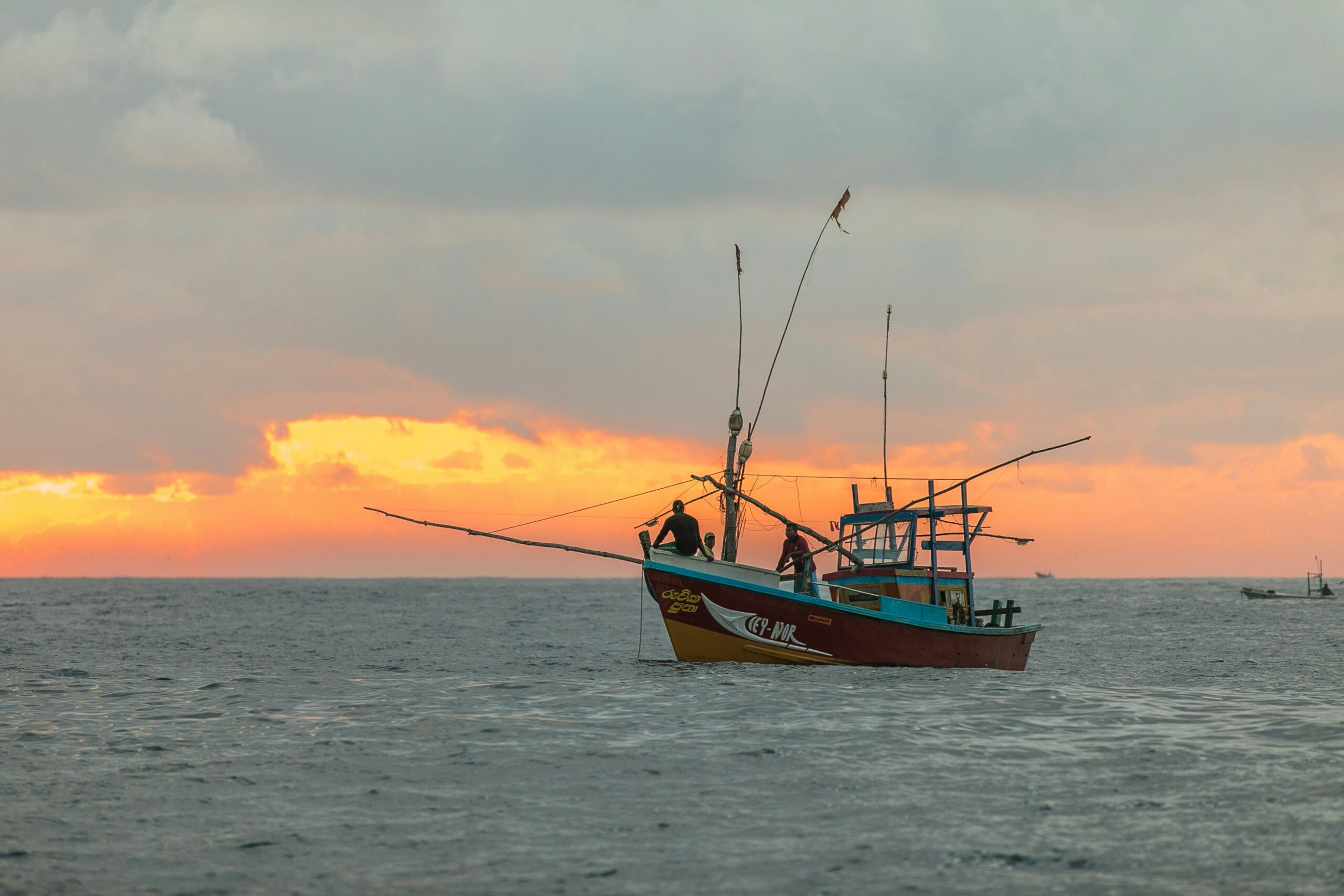
A low white light disappears in the trough between waves, then returns slightly brighter. The AIS display need not change at all. This is the ordinary difficulty of fishing boats without AIS: the water can contain a vessel, its crew and a spread of gear while the screen offers no name to attach to any of them. The first useful observation is that something is there. Identifying it comes afterwards.
For the Asian archipelagos on the Naora Global Expedition route, we plan around that distinction. These are not uniform waters, and neither fishing methods nor reporting requirements can be carried unchanged from one jurisdiction to another. What travels well is the discipline of keeping the view through the window separate from the picture assembled electronically, then making the two inform each other.
A tidy display is attractive because it appears to have finished the work of interpretation. A fishing ground rarely offers that satisfaction. The task aboard Discovery is to make the water sufficiently legible to pass through it with care, without pretending that everything in it has become predictable.
Finding Fishing Boats Without AIS
AIS, the Automatic Identification System, depends on another vessel transmitting information that our equipment can receive. It is not a detector of everything afloat. Many small working boats are outside compulsory carriage requirements, which vary with vessel size, service and jurisdiction. Others may have equipment that is not transmitting or whose signal does not reach us. An absent symbol tells us very little about an absent boat.
Nor should we treat the absence as evidence of poor seamanship or suspicious intent. A small fishing vessel can be conducting entirely ordinary work without appearing on our display. Our lookout must account for it regardless. The obligation to see what can be seen does not depend on another person supplying us with an electronic introduction.
The visual search needs structure. We scan the whole horizon, return more frequently to developing contacts, and look into the water ahead rather than only at the distant lights. A low float may become visible much later than the boat tending it. Bright deck lamps can conceal the lower, less conspicuous navigation lights nearby, while reflections can make the apparent footprint of a vessel difficult to judge.
At night, a screen bright enough to illuminate a hand beside the controls is also bright enough to interfere with looking outside. Eyes can take about 20 to 30 minutes to adapt well to darkness, and a brief exposure to strong light can undo useful sensitivity. We dim displays while keeping them readable and avoid unnecessary white light. The small physical act of looking away from the instruments matters: shoulders turned, sightline clear, enough time outside for a faint object to emerge from the black water.
Taking Bearings On Fishing Boats Without AIS
A light’s position against a window frame is not a reliable collision assessment. A sailing yacht yaws, and a light can slide across the glass because our heading has changed rather than because the other vessel is passing clear. Repeated compass bearings give us a reference that does not move with the window. They need to be taken from a suitable position, with attention to magnetic interference and a consistent method.
The useful record is simple: which contact, at what time, on what bearing, with what observed behaviour. In a crowded view, distinguishing the low white light from the brighter cluster beyond it is part of the work. A precise bearing attached to the wrong contact produces a more convincing mistake than an openly uncertain observation.
If a contact remains on substantially the same compass bearing while its range decreases, collision risk must be taken seriously. Visual range at night is often uncertain, however. Brightness is a poor substitute: a powerful lamp far away can appear more urgent than a weak lamp close aboard. We do not wait for an exact distance before treating a persistent bearing as a developing concern.
A changing bearing is useful evidence, not permission to forget the contact. A close vessel, a tow or an extended spread of fishing gear can still present danger even when the visible light is moving across the horizon. The bearing belongs to the object we can see. It does not establish where an unseen line ends.
When action is required, it should be early, clear and consistent with the encounter and the collision rules. Then comes the part easily neglected: checking that the action is working. A new heading is not the end of the assessment. We continue observing until the vessel and its working area are safely past, while making sure our alteration has not created a problem elsewhere.
What Radar Can And Cannot Show
Radar answers a different question from AIS. It receives reflections from objects rather than waiting for those objects to transmit their identity. A boat without AIS may produce a perfectly useful radar echo. But a low wooden or fibreglass hull can also give a weak, intermittent return, depending on its construction, metal equipment, aspect, sea state and the installation observing it.
The echo can be lost among returns from breaking water or rain. Controls that suppress this clutter can also suppress small targets if used too aggressively. A beautifully clean radar picture may therefore represent less information, not better information. We want a usable picture of the actual conditions, rather than a display made visually reassuring by removing everything inconvenient.
Range scale changes what receives attention. A 6 Nm scale can help reveal traffic developing farther out; a 1.5 Nm scale gives the nearby water more screen space. Those are illustrative working scales, not settings prescribed for every passage. Spending all our time on the close view risks missing the next encounter. Remaining on the wider view can make a small nearby return easy to overlook. We move between the needs of the immediate water and the approach beyond it.
An automatically tracked target introduces another layer of interpretation. Its calculated course and closest approach depend on a sufficiently stable sequence of observations and sound inputs. A weak echo that disappears between sweeps, or a fishing boat repeatedly changing course, may not support the confident vector drawn beside it. A movement vector is not a measurement of where its bow points, still less of where its gear lies.
The important limitation is that our methods can fail together. Rain can obscure the view and complicate the radar picture at the same time. Small size can make a boat difficult both to see and to detect. Adding displays does not automatically add independent certainty. Sometimes the correct response to poor information is less speed and more room.
Reading Fishing Lights And Gear Markers
The prescribed lights contain useful distinctions. Green over white identifies trawling; red over white identifies other fishing that restricts manoeuvrability. Depending on the vessel’s activity and movement, further lights may be required. Knowing these patterns matters, but recognising part of a pattern is not the same as positively identifying the whole vessel and its work.
A lamp may be obscured by equipment, lost against shore lighting or visible only intermittently as the boat moves. Powerful working lights can overwhelm subtler signals. An isolated white light does not, on its own, tell us whether we are looking at a vessel underway, an anchored boat, a marker or something ashore. We retain the uncertainty instead of selecting the most convenient explanation.
The collision rules also distinguish a vessel engaged in fishing with gear that restricts manoeuvrability from a fishing boat simply travelling between places. Its occupation and silhouette do not establish its present status. Being under sail aboard Discovery does not provide a general entitlement to continue through another vessel’s working area, and narrow channels or traffic lanes add obligations that cannot be reduced to a simple hierarchy.
Gear is where the visible picture becomes particularly incomplete. Floats may indicate only parts of a line. Current can set gear away from the apparent alignment of its markers. Two separated boats may be working together, and the water between them may be the last place to seek a shortcut. Equally, automatically passing astern is not a universal solution: some fishing methods put the obstruction precisely there.
A predicted closest approach of 0.5 Nm might sound generous when read as separation between hulls. It says nothing certain about clearance from uncharted gear extending beyond one of them. We look for the shape of the operation, not merely the nearest boat. If that shape remains unclear, a wider route around the activity is generally more useful than trying to thread individual lights. A radio call can help, but silence or an uncertain reply cannot become permission to proceed.
Choosing A Safe Speed In Working Water
Speed determines how much unfinished interpretation we can afford. At a closing speed of 12 knots, a contact 1 Nm away is only five minutes from reaching our position if the relative track leads there. At a closing speed of six knots, the same distance gives ten minutes. These are simplified examples, not predictions for an encounter, but they show why an apparently modest change in speed can alter the workload substantially.
Closing speed belongs to both vessels’ movements. Halving our speed does not necessarily double the available time, especially with another boat approaching us. What reducing speed does provide is a slower rate at which we enter new water, more opportunity to assess nearby gear and, depending on conditions, a shorter distance travelled before an effective manoeuvre begins.
The distinction between speed through the water and speed over the ground matters here. A yacht making four knots through the water with a directly following current of three knots travels over the ground at seven knots. It can feel restrained at the helm while still closing a fixed obstruction quickly. A drifting fishing boat and anchored gear present different relative movements in that same current. One speed figure cannot describe the whole encounter.
Slowing also has limits. We need sufficient control for the conditions, and stopping propulsion does not stop the tide carrying us towards a shoal or a line. The decision is therefore not simply to go as slowly as possible. It is to choose a speed at which observation, manoeuvrability, stopping response, visibility and available water remain in balance.
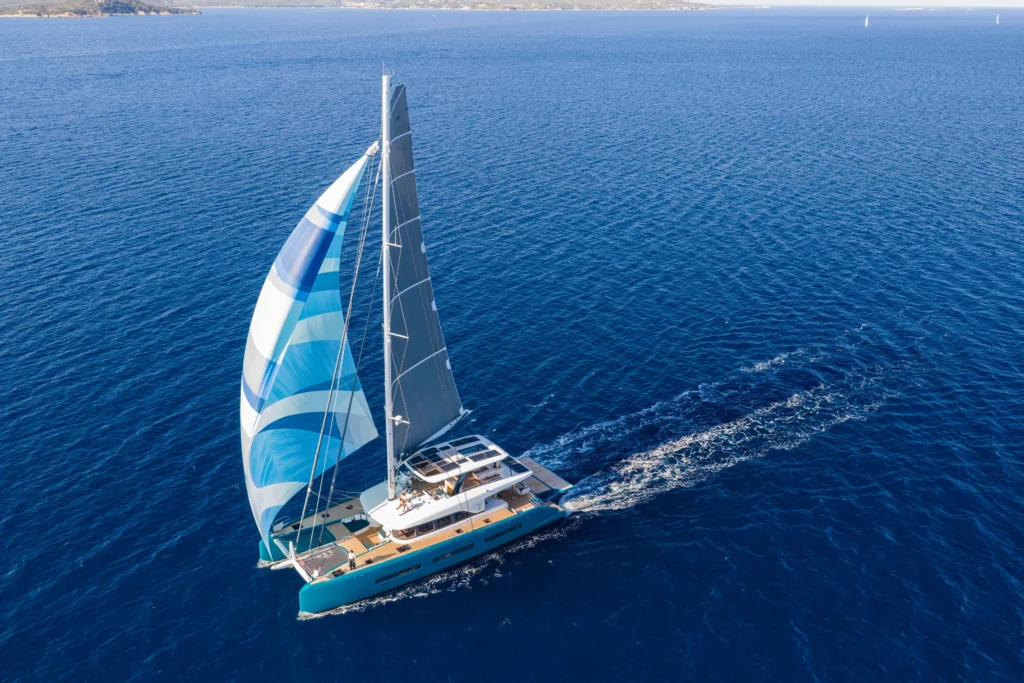
On a sailing catamaran, that decision starts before the crowded patch. The sail plan must allow manageable control, and propulsion must be ready if conditions require it. We do not want a hurried sail reduction competing with the lookout at the moment several lights become ambiguous. Nor is applying power blindly beside suspected gear a harmless escape: a line caught around propulsion can remove the control we were relying on. Preparation keeps the options real.
Planning Clearance Before The Water Narrows
Generous clearance has to fit within navigable water. Turning away from fishing activity without checking the depth, nearby shoals, traffic and current can replace a visible uncertainty with a charted danger. Before entering a constricted area, we need to know where an alteration remains possible, where it does not, and where we could safely delay without obstructing other vessels.
The route drawn through an archipelago is therefore only part of the passage plan. We consider the likely direction of set, the visibility expected during the transit, the room available outside the intended track and the consequences of arriving later. Seasonal weather informs that preparation, but the actual forecast and observed conditions decide the passage. There is no single Asian season or current regime that answers these questions across the region.
Daylight often improves our chances of seeing small floats, colour changes and the connections between vessels. It is a useful preference, not an assurance. Low sun can turn the water ahead into glare, rain can erase the next headland, and fishing activity may still occupy the convenient passage. A daylight arrival has value only if we remain willing to change the plan when the daylight picture is poor.
There is also a fair counterpoint to the instinct to move farther offshore or make a large detour. Outside the fishing activity may lie deeper water, but also stronger current, commercial traffic or more exposure to the weather. Greater distance from one hazard is not automatically a safer passage overall. We compare the complete alternatives, including waiting in a suitable place. The cost may be time, extra distance or a different arrival. Those costs belong in the decision before anyone becomes attached to an expected hour ashore.
Keeping The Lookout Through A Watch Change
Sven, Naora’s founder and captain, plans every weather window and sails every leg himself. That continuity does not turn a demanding approach into work for one pair of eyes. Looking outside, interpreting radar, checking the chart and controlling Discovery are distinct tasks, and the attention available for each shrinks when they compete. Additional lookout support needs to be arranged before workload becomes excessive.
The physical arrangement matters. A person looking through glass with reflections across it does not have the same view as someone in a clear, protected position outside. Wind across the ears can mask a small engine; wave noise can conceal it again. Hearing is part of the lookout, but an engine note does not supply a dependable range. We use what it tells us without asking it to tell us more.
A handover in this water must transfer uncertainty as carefully as established facts. The relieving watch needs to see the actual contact being discussed, understand which echo may belong to it and know what remains unresolved. Saying that a light has been moving clear is incomplete without explaining whether the clearance has been verified and whether gear has been seen nearby. If the situation is developing rapidly, completing the manoeuvre before changing responsibility may be the better judgement.
After a course alteration, attention naturally stays with the boat that prompted it. We deliberately widen the search again. There may be another low light on the new track, a marker nearer than the first, or traffic approaching from a direction that previously seemed unimportant. The watch continues beyond the moment of apparent relief.
There is no need to make this water feel menacing. Its difficulty comes partly from the fact that it is being used for purposes other than our passage, by people attending to tasks we may only partly understand. A deck lamp that complicates our night vision may be lighting the hands lifting a catch. We are passing through someone’s working night.