Through a mask, a reef fish can look entirely sound: clear eyes, intact scales, a steady movement of the gill covers as it holds against the water. In Caribbean spearfishing, none of those observations answers the question that matters before taking it for the table. A fish carrying ciguatoxins may look and behave like the fish beside it. The diver has no visible mark to read.
That changes where the real work belongs. Accuracy, breath control and the ability to identify a species remain important, but the decision about food begins ashore, with the catch area, current local advice and an understanding of what the fish has been eating. Some of that work will end in a refusal. It should end there before a shot is taken.
As we prepare the Caribbean chapter of the Naora Global Expedition, our starting point aboard Discovery, the Lagoon Eighty2 sailing catamaran, is a meal that does not depend on anyone catching a fish. This removes a quiet pressure from the water. Dinner is already possible. The fish has to justify being taken, rather than the diver having to justify returning without it.
How Ciguatera Moves Through A Reef
Ciguatera is poisoning caused by eating fish containing ciguatoxins. The toxins originate with certain microscopic dinoflagellates, including species of Gambierdiscus, that live on algae and other submerged surfaces. They do not announce themselves as a coloured slick that a diver can avoid. Clear water and a reef full of active fish are compatible with their presence.
Grazing fish can ingest the toxin-producing organisms while feeding. Other fish eat those grazers, and predators eat the smaller predators. Toxins can accumulate through these feeding relationships. The important geography is therefore larger than the patch of bottom beneath a fish when we encounter it. Its exposure reflects a feeding history, not simply its position at the moment of capture.
This is why food-web position matters. A predator may have consumed many contaminated prey over time, concentrating exposure that began with organisms too small to notice from the water. But the pathway starts below the predators. Choosing a herbivorous fish does not remove the mechanism, and a fish need not occupy the top of the food web to carry toxins.
The distinction from spoilage is essential. Ciguatera does not begin because a fish has been left warm in a bucket or handled badly in a kitchen. A fish can be caught cleanly, dispatched promptly, chilled correctly and prepared with care, yet still cause poisoning. Those practices remain necessary. They control different hazards.
Nor can we read toxin levels from the apparent health of the reef. Understanding the ecology helps us identify reasons for caution; it does not turn underwater observation into a food-safety test. The beauty of a place is evidence of what we can see. We must not make it answer for what we cannot.
Caribbean Spearfishing Begins Before The Dive
Before deciding to fish, we need the current local health advisories as well as the rules governing fishing itself. These are separate enquiries. A protected area, a closed season or a prohibition on spearguns can settle the matter immediately, but permission to fish is not permission to assume the catch is safe to eat. Conservation rules and ciguatera warnings address different questions.
A useful advisory needs to be read closely. Which species does it concern? Does it describe a particular catch area or a wider restriction? When was it issued, and has it been updated? An old notice remains relevant to the history of a place, but it cannot establish present conditions by itself. Equally, finding no notice is not the same as finding evidence of safety.
Local fishing knowledge adds something a general warning cannot: distinctions between grounds, names used for particular fish, and the catches that experienced people decline to bring home. The conversation needs to be specific. We want to know where a fish was caught, rather than where it was landed or sold, and whether a familiar market name identifies one species or several.
That knowledge deserves attention without being turned into a guarantee. Someone having eaten a species for years without illness does not establish the toxin content of the next individual. Reports also have gaps. An illness may never be recognised, and a visitor may be elsewhere by the time symptoms develop. Silence around a landing place can mean several things.
When advice is unclear, inconsistent or unavailable, our answer is not to substitute confidence. We can leave reef fishing out of that stay. There is a practical cost to this, particularly when someone has looked forward to catching dinner, but it is a small cost compared with taking an uncertainty aboard and dividing it between everyone at the table. An attractive dive site does not create an obligation to hunt there.
Why Species And Size Cannot Clear A Fish
Barracuda is a clear reason for refusal in our Caribbean planning because of its recognised association with ciguatera. Some groupers, snappers and other reef-associated predators also warrant particular caution. These names are useful warning categories, not a complete inventory of potentially affected fish. A fish absent from a short mental list has not thereby passed an assessment.
Identification needs to be more exact than colour or a broad family name. Several species may share a local name, while the same species can carry different names between communities. If we cannot identify a prospective catch confidently, we cannot reliably match it to species-specific advice or fishing restrictions. That uncertainty is sufficient reason to leave it alone.
Size is more difficult because it offers such an appealing shortcut. Larger, older predators may have had more time to accumulate toxins, which gives avoiding them a sensible basis. But accumulation depends on exposure as well as age. A smaller fish from an affected food web can still contain enough toxin to cause illness. There is no universal length or weight below which a Caribbean reef fish becomes safe.
A local size restriction may still matter and must be respected. What it cannot do is certify every fish beneath its limit. Nor should a legal minimum size, often intended to protect reproduction, be mistaken for a food-safety threshold. The same measurement can serve entirely different purposes, and confusing them produces a reassuring number with no reliable meaning for the meal.
Catch location, species and size therefore work as reasons to exclude fish, not as stamps of clearance. Enough may be known to say no while too little is known to say yes with confidence. The most conservative way to avoid this particular reef-fish exposure is not to eat tropical reef fish. A more selective approach can inform choices, but it cannot honestly promise to eliminate the risk.
Making The Decision Before The Shot
Underwater is a poor place to begin resolving an uncertain food decision. Light changes colour, the fish changes angle, and the current presses against a fin blade while attention narrows towards the shot. On a breath hold, the need to return to the surface adds its own urgency. None of this improves the quality of a half-remembered warning.
The exclusions belong in the discussion before entering the water. If the area is unsuitable, the speargun stays aboard. If a species is excluded, a particularly convenient encounter does not reopen the decision. If identification remains uncertain, the fish stays. Selectivity is useful only when it survives the moment in which taking something becomes easy.
This also keeps hunting judgement separate from freediving safety. A trained buddy needs to provide dedicated supervision, including the ascent and recovery at the surface, rather than both divers becoming absorbed in fish below. Uncertainty is never a reason to extend a dive or pursue a fish beyond a comfortable return. There will be time to discuss it while breathing normally.
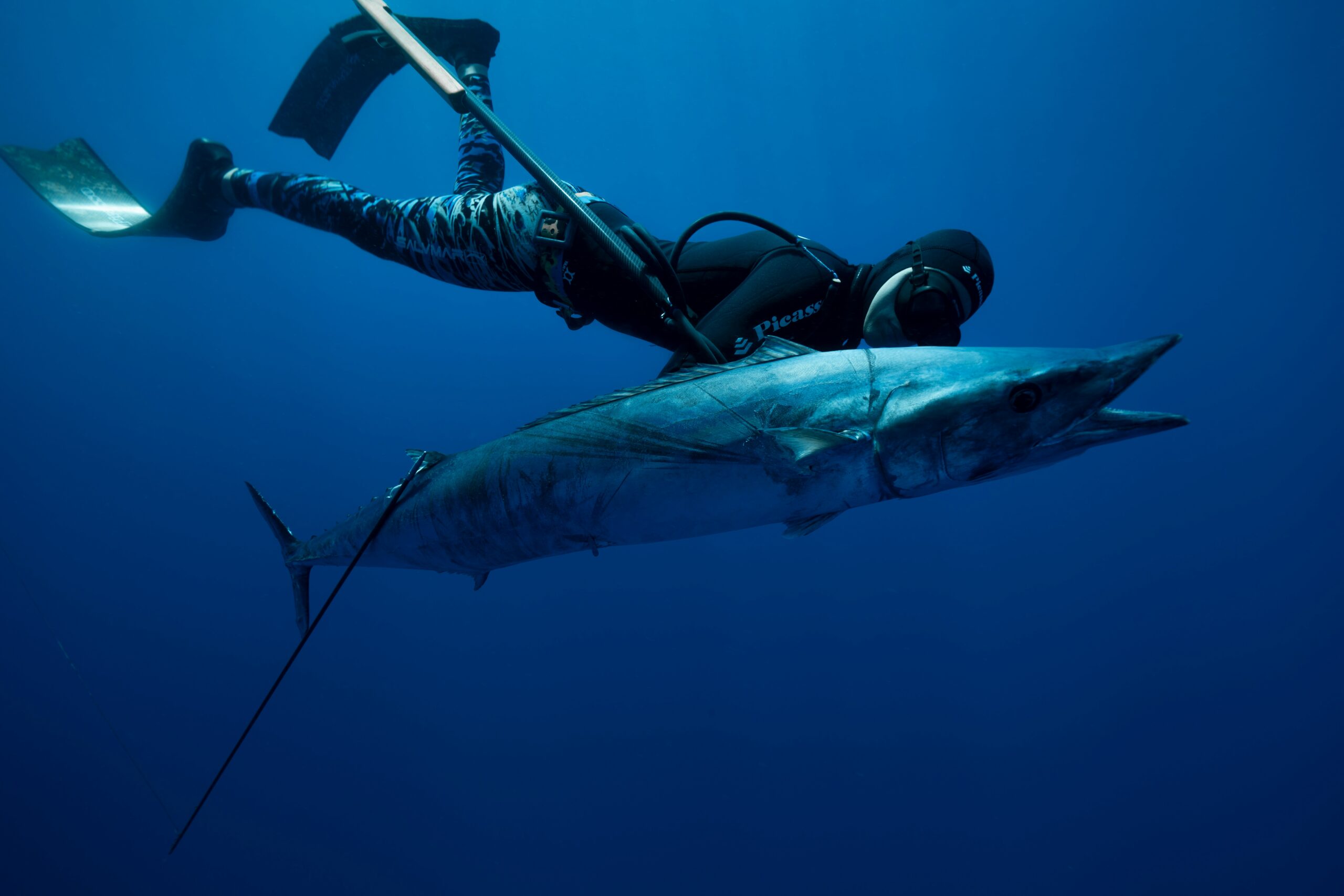
Spearfishing has a genuine advantage here: the animal can be observed before it is taken. That makes restraint possible at a stage when it still benefits the fish. Killing first and researching later wastes that advantage. So does treating a successful shot as an argument for keeping a catch whose suitability was never established.
There is a fair counterpoint. People have fed their households from these waters for generations, and their distinctions between fish and fishing grounds can be detailed and valuable. Our caution should not become a lecture about their home. But responsibility for our own table remains ours. Listening respectfully and declining a fish can belong to the same encounter.
Why Cooking And Freezing Do Not Make It Safe
In the galley, most of the familiar signs point towards control. Ice drains from a tray, a clean knife passes through firm flesh, and a thermometer gives a number that can be checked rather than guessed. These are useful disciplines. The difficulty with ciguatera is that excellent handling can coexist with a hazard none of those disciplines removes.
Keeping fish at 4°C or colder helps control bacterial growth during refrigerated storage. It does not reduce ciguatoxins to a safe level. Similarly, a fish cooked to 63°C at its centre, a familiar food-safety target, can still carry the toxins. The cold chain and the cooking temperature have done useful work, but they have not answered the ciguatera question.
Ciguatoxins are heat-stable. Ordinary cooking does not reliably destroy them, and freezing does not remove them. Grilling harder, making a soup or saving the fillets in the freezer cannot rescue a questionable catch. Citrus changes the texture and flavour of fish in a marinade; it is not a detoxification method either. There is no galley technique that turns this uncertainty into a dependable meal.
Toxins can be more concentrated in organs such as the liver and in parts including the head and roe, which gives avoiding those tissues a sound basis. But the flesh can also contain them. Gutting a fish or serving only a carefully trimmed fillet does not make an affected catch safe. The decision cannot be reduced to which parts the cook removes.
Smell and taste offer no dependable warning. A small test portion is exposure, not a test, and folk methods involving metal, insects or other animals cannot establish safety. We should not expect a practical onboard check to certify an individual wild reef fish as toxin-free. The absence of an unpleasant flavour is particularly deceptive because it arrives at exactly the moment people expect their senses to protect them.
The same reasoning applies to fish bought ashore. A beautifully iced display tells us something about handling, not everything about origin. Sourcing locally matters to Naora, but proximity is not a substitute for traceability. If the catch area and species remain uncertain, choosing another ingredient is consistent with respecting the place. It does not diminish the skill of the person cooking.
Recognising Illness At Sea
Ciguatera can begin with nausea, vomiting, diarrhoea and abdominal pain, often within 1 to 6 hours of eating contaminated fish. Timing varies, and neurological symptoms can be delayed for up to four days. An uneventful evening therefore cannot clear the remains of a meal for tomorrow. Nor should a suspected case be dismissed because it does not follow the expected sequence.
Tingling, itching, unusual weakness and altered temperature sensation are important clues. Cold objects or water may feel painfully hot or burning. This is sometimes described as temperature reversal, although the experience is not necessarily a neat exchange of hot and cold. It is also not present in every case. Waiting for that distinctive symptom would be a mistake.
At sea, vomiting and weakness can initially be confused with motion sickness, heat or fatigue. The useful response is to connect symptoms with the recent meal and seek medical advice promptly, rather than argue for the most convenient explanation. Breathing difficulty, collapse, marked weakness or signs of a disturbed heartbeat require urgent assistance. No one needs to wait for another diner to become ill.
Stop serving the fish. Record when it was eaten, the species if known, the catch location and who shared the meal. Retain any remaining fish sealed and clearly labelled, chilled or frozen for possible testing under medical guidance, rather than offering it to someone else. Freezing here preserves a potential sample. It does not make the remainder fit to eat.
There is no specific antidote that makes this a minor interruption to a passage, and neurological symptoms can persist for weeks or months. Medical care matters, including assessment of dehydration and cardiovascular effects. Distance from care also matters. For a yacht, the consequences include communications, a possible change of course and the condition of everyone who ate from the same catch. Prevention belongs in provisioning and passage judgement, not only in the diving conversation.
What We Keep From Caribbean Spearfishing
A proper alternative meal changes the emotional weight of all this. With vegetables, pulses, rice and other provisions already aboard, declining a fish does not leave a hole in the day that someone must urgently fill. There is still chopping to do, a pan to put on and a table to lay. The galley can follow what is responsibly available rather than make the water meet an expectation.
This is a practical expression of selective fishing, which otherwise risks becoming a pleasing phrase attached only to the fish we keep. Selection also includes the animal we cannot identify, the predator from a poorly understood ground and the apparently perfect catch that falls within a local warning. Those refusals should be ordinary enough that nobody needs to defend them over dinner.
A dive can then remain worth the time without producing food. A grazing fish works across the bottom; another holds just beyond the shelter of a ledge. Watching their feeding begins to reveal the relationships that the ciguatera decision asks us to understand. We are visitors to that system before we are potential participants in its food chain.
For an expedition moving between regions, this is knowledge that must remain unfinished. Experience elsewhere can sharpen the questions, but it cannot supply every local answer. We arrive, listen and sometimes leave the speargun dry. Below, the fish remains part of the place we came to see.