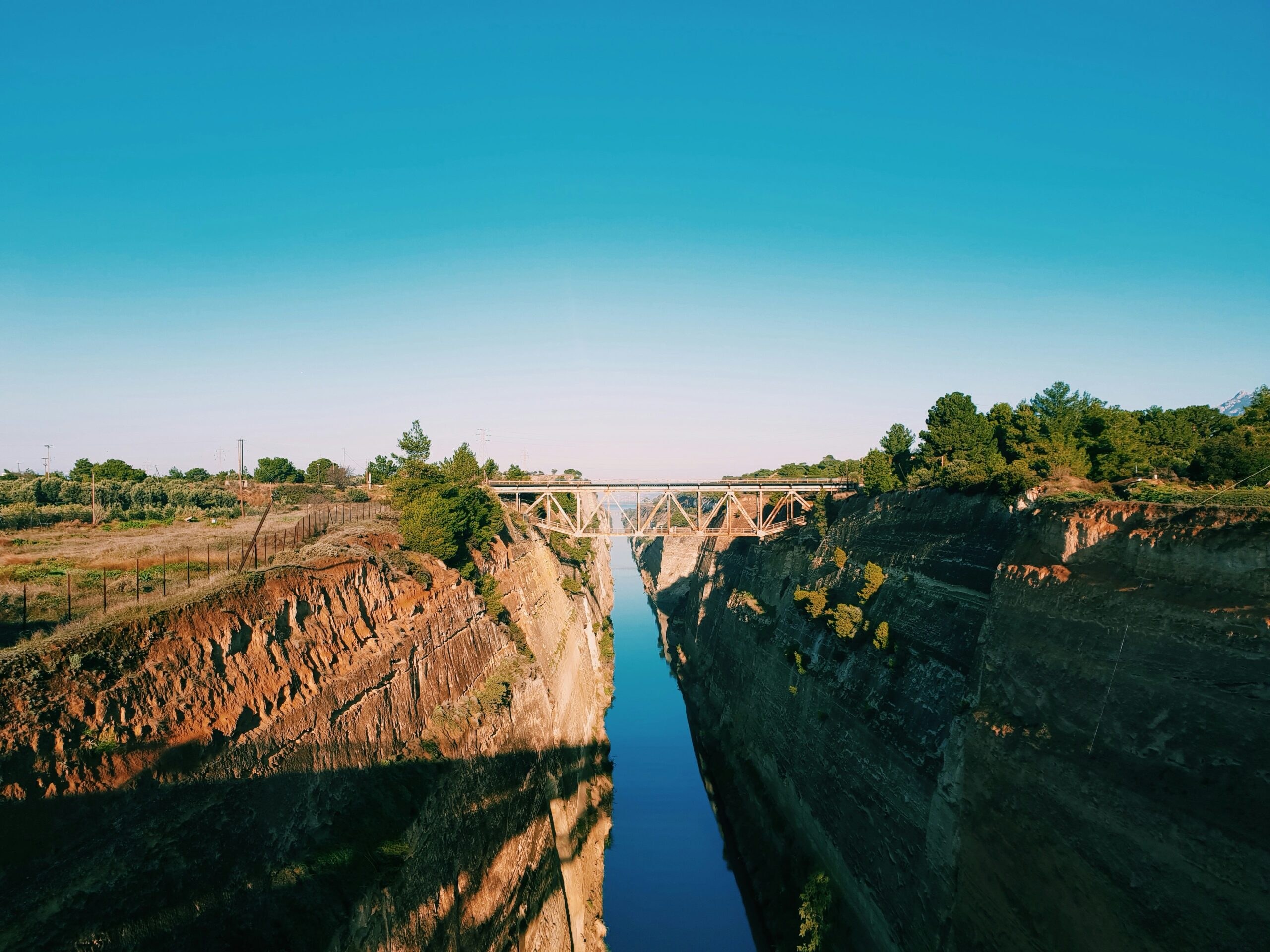
On the route plan, the Corinth Canal transit occupies a very small part of a very long voyage. Its approximately 3.4 Nm can make it look like an interval between passages rather than a passage in its own right. Yet the first dimension we need runs across Discovery, not along the route. Before the walls become a view from the deck, her beam has to become a number we can use.
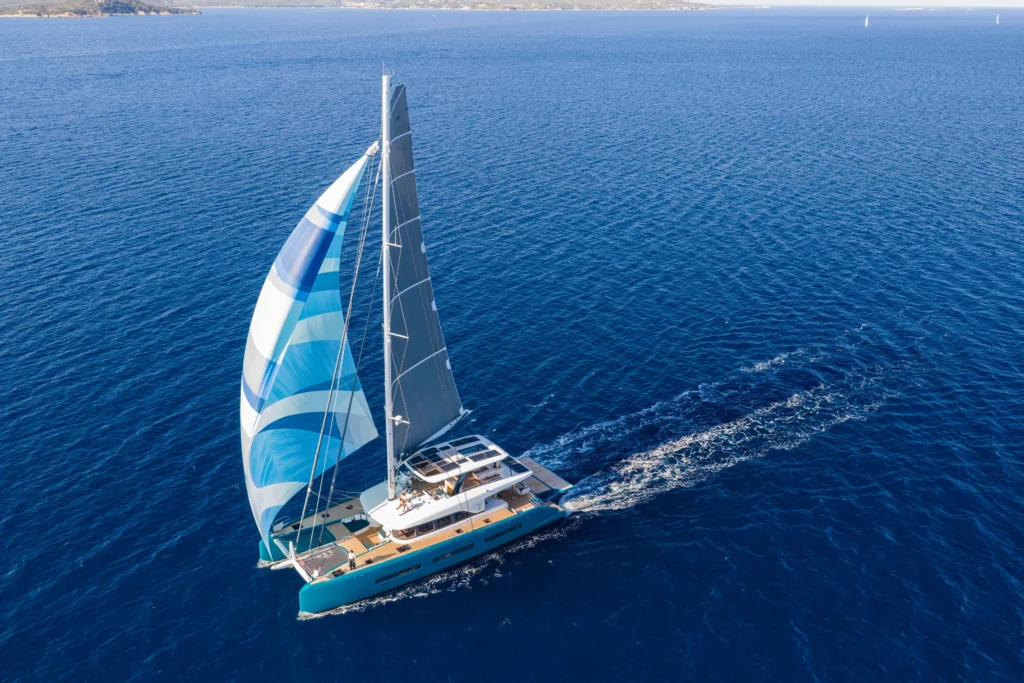
Discovery is a 2025 Lagoon Eighty2 sailing catamaran. The width that gives her living spaces their openness, and separates the movement and machinery of her two hulls, becomes a different consideration in a narrow cutting. Nothing about the yacht changes. The space around her does.
We are preparing for this passage within the Mediterranean part of the Naora Global Expedition, not describing a transit already completed. Its inclusion in our route around the world does not establish that the canal will be operating when we arrive, or that we have permission to enter. Those are separate questions, and each needs its own answer.
Corinth Canal Transit Notices And Entry Instructions
The first practical task is to establish what the canal is allowing at the time we intend to pass. An opening announced in advance is useful for planning, but it does not settle the position on the day. Maintenance, inspections, works and temporary restrictions can change the answer. We need the operating notices effective for our passage, with their dates and conditions understood, rather than a remembered opening pattern from another season.
That check belongs early enough in the planning to leave a genuine choice. Finding out that a passage cannot proceed is manageable while there is time and sea room to revise the surrounding voyage. Discovering it at the entrance, with people expecting to be somewhere that evening, adds pressure without adding any navigational information. We would rather spend that time before departure than argue with it afterwards.
For Discovery, the working exchange must establish the applicable limits for beam, draught and air draught, any requirements for pilotage or tow assistance, the reporting procedure and the instructions for waiting and entering. We also need to know how traffic will be sequenced and what restrictions apply to our movement. A vessel being physically smaller than a channel does not, by itself, make that vessel admissible.
There is an important distinction between submitting the yacht’s particulars, receiving acceptance for a transit and being told to proceed. We keep those stages separate. The final movement instruction belongs to the actual approach, with our position and readiness understood. Sven, Naora’s founder and captain, plans every weather window and sails every leg himself. Here, that responsibility includes leaving space in the plan for an answer that is not the one we hoped to receive.
Beam And The Space Discovery Actually Occupies
The Lagoon Eighty2 has a nominal beam of 11 metres. The canal’s nominal width at the waterline is roughly 25 metres. Put those figures beside each other and the initial arithmetic appears reassuring: a centred yacht would have approximately 7 metres on either side. That is useful for understanding scale. It is not a clearance assessment.
The calculation assumes that the stated channel width applies where we need it, that the yacht is exactly centred and aligned, and that her declared beam describes everything projecting sideways in the transit configuration. It also treats the water as still and the yacht as motionless. Real clearance begins where those assumptions end.
We therefore need Discovery’s own dimensional record checked against what is actually aboard. The hull beam is one part of the envelope. Any equipment projecting beyond it matters too, as do fenders if they are required for the agreed procedure. Their presence cannot be ignored because they are soft, and carrying them is not a plan for making contact with a canal wall. The intention remains to preserve water between the yacht and the structure.
Heading matters as much as position. When a long yacht yaws, part of her length begins to occupy space across the channel. The bow can appear comfortably clear while a stern is moving towards the opposite side. A lookout who reports only the nearest point ahead gives the helm an incomplete picture. We need to understand both translation and rotation: where the whole yacht is going, and how her angle is changing.
There is a useful counterpoint here. The dimensional assessment may establish a comfortable margin in the permitted conditions. Preparation should not turn a manageable passage into a performance of anxiety. Its purpose is to find out which part of that apparent space is genuinely available, and which part has already been committed to movement, uncertainty and the ability to correct.
Air Draught And Underwater Clearance
The same distinction applies vertically. The canal’s nominal depth of roughly 8 metres gives an impression of its scale, but it is not a statement of the least available depth along our authorised track on a future transit day. A general dimension cannot account for a local restriction, an underwater obstruction or a changed operating limit.
Below Discovery, we need her actual loaded draught, allowing for fuel, water, stores and trim. Above her, we need the height of her highest fitted point above the water, not simply the mast dimension on a drawing. An antenna or instrument can be the limiting point. A measurement taken from the wrong starting level can be precise and still be useless.
Bridge clearance and water depth also have reference levels. They must be brought onto a common basis before subtraction means anything. Higher water ordinarily gives more depth beneath the keel and less space above the mast. Lower water reverses that relationship. The change does not have to be dramatic to matter when a decision depends on the remaining margin, and the nominal height of a bridge must not be confused with the usable clearance beneath its lowest relevant obstruction.
The road bridges at the canal entrances introduce another distinction: they lower into the water to allow vessels through. Seeing an open gap is not the same as knowing that a bridge has completed its movement and that the permitted depth is available above it. We follow the movement instructions rather than interpreting the appearance of the entrance as an invitation.
On board, the depth display needs equally careful interpretation. A sounder may show depth below its transducer or a value adjusted to another reference, depending on its configuration. Before using it to judge under-keel clearance, we need to know the offset. A display showing a reassuring number is not helpful if the person reading it believes that number begins at the keel when it begins somewhere else.
Preparing Discovery Before The Canal Approach
A narrow passage is a poor place to discover that a control behaves differently from the way the helm expects. Before reaching the confined approach, propulsion and steering checks belong in water where there is room to make them safely. Each engine must respond as expected, the steering must behave correctly, and the relevant indications and alarms must make sense. The checks are functional, not merely a glance at illuminated instruments.
The passage is planned under power, with sails secured and loose gear stowed. We want nothing demanding attention because a line has worked free or an item on deck has begun to move. Any equipment needed for the instructed arrival or waiting procedure should be accessible without someone having to search through a locker at the moment it is required.
We will agree the working positions before entry. The helm needs reports from parts of the yacht that cannot be judged reliably from a single viewpoint, particularly the sterns and the side nearest a wall. Useful reports describe a trend as well as a gap. A clearance that is slowly opening asks for a different response from the same apparent clearance that is closing.
For those travelling with us, the briefing can remain simple. We explain where they can watch comfortably, which sightlines and working areas need to remain clear, and why this is a period when the crew’s attention should not be divided. The walls will naturally draw faces upwards. Our job is to ensure that someone is still looking at the water beside the hulls.
The response to a propulsion or steering problem also needs discussion before the entrance, including immediate communication with canal control and the limitations of the available options. There is no value in inventing an elaborate emergency in advance. There is considerable value in knowing who reports, who acts and which actions could make a confined situation worse.
Corinth Canal Transit Speed And Steering
The most easily misunderstood instruction in confined water is to go slowly. It is sensible as a warning against haste, but incomplete as a steering policy. A yacht needs enough control to hold her intended track. Reducing speed until the rudders have little useful flow across them may reduce forward movement while allowing wind or current to make the more important decision.
The distinction is between speed over the ground and speed through the water. With a following current, a yacht can be making noticeable progress past the wall while moving much more slowly through the water around her rudders. Against a current, the reverse applies. The plotter’s speed alone does not tell the helm how much steering response to expect. We need to read the yacht’s response alongside her progress and comply with the operating instructions, rather than chasing a single reassuring number.
Discovery’s separated propellers offer useful control through differential thrust, but they do not remove her inertia or make her move sideways on command. An engine correction can alter heading while the yacht’s existing sideways movement continues. Large alternating corrections can become their own problem, especially if the person at the helm is watching the bow and waiting for it to look centred before considering what the sterns are doing.
Confined water adds another variable. Water moving around a hull and through a restricted gap changes pressure, and interaction with a nearby bank can introduce an unwanted turning moment. Shallow or restricted water can also increase a vessel’s effective draught through squat. The strength of these effects depends on speed, hull form, depth and the shape of the available waterway. They are reasons to preserve margin and avoid unnecessary speed, not reasons to apply a borrowed calculation as though every yacht behaves alike.
Inside the cutting, reflected engine sound can make the machinery seem louder without any change in its setting. Stone passing close beside the deck makes movement more apparent than an open horizon does. Those sensations deserve recognition, but they are not instruments. The useful observations remain the yacht’s alignment, the changing gaps at bow and stern, her response to small inputs and the water moving along her sides. Early, measured corrections leave more room than waiting for the picture to become uncomfortable.
Traffic Instructions And Crew Attention
We should not infer permission from another vessel beginning to move. Traffic sequencing is managed, and an instruction intended for someone ahead is not an instruction for Discovery. Before the approach, the required communications arrangements need to be settled, including the working channel and reporting points. A remembered channel from an earlier visit is not sufficient preparation for a future one.
At the helm, an instruction has to survive the actual sound of the boat. A VHF call can arrive over ventilation, machinery and conversation, and the important word can be the one lost in the noise. If it is unclear, it gets repeated. Position, vessel identity and any movement instruction must be understood without the crew having to guess whether they heard permission to prepare or permission to proceed. Quiet on deck has a practical use here.
The chart display remains valuable, but its route line is not a visible strip of safe water. A centred symbol cannot establish the clearance of a stern, and satellite positioning near steep structures can be affected by obstruction and reflected signals. We will use the display as part of the picture, with visual observations and the yacht’s behaviour supplying information it cannot provide.
If the transit proceeds, there will be moments when the stone takes most of the view and the strip of sky above it seems detached from the water below. From a seat on deck, that can be the whole experience. From a working position, the same scene contains a changing shadow on the hull, a stern drawing nearer or farther away, and a voice waiting for a clear gap on the radio. The atmosphere and the work occupy the same space.
The Exit And The Decision To Wait
The passage plan must continue beyond the far entrance. The end of the walls is not necessarily the end of traffic management, and the water outside may expose the yacht to wind or sea conditions that were less apparent within the cutting. We need to know where we are going after release from the transit, with room to regain the ordinary rhythm of navigation before anyone treats the task as finished.
Waiting also needs a plan. It should mean an agreed position and a safe way of remaining there, not an accumulation of yachts improvising near an entrance. If conditions, operating instructions or a defect leave us without an acceptable margin, the sensible decision may be to delay or revise the passage. That costs time and can change expectations ashore. It does not become a worse decision because the canal itself is short.
A long expedition gives this small passage its proper context. Corinth matters, but it cannot be allowed to turn into an appointment that overrules the yacht’s condition or the day’s instructions. The distance ahead is too substantial to make a habit of spending margins simply because they appear generous.
I would like the view from Discovery to feel unhurried: stone close enough to study, the steady note of the engines, no sudden demand for anyone to move. That ease depends on work done while there is still open water around us. Between the hull and the wall, empty water is doing useful work.