The market is the most honest part of any city. Not the most polished, not the most curated, not the most intentionally representative of what the city wants the visitor to think it is. The most honest: the place where the city feeds itself, where the ingredients of the daily life are exchanged between the people who produce them and the people who will prepare them, where the social architecture of the community is visible in who sells what to whom and at what hour and with what degree of negotiation.
Three markets on three continents that the Naora route passes through. Three different cities, three different food cultures, three different social architectures visible in the same form: the stall, the buyer, the transaction, the morning hour before the heat makes it something other than what the market was built to be.
Thessaloniki, September
The Modiano market in Thessaloniki is a covered market hall built in 1922 by the Jewish merchant Eli Modiano in the architectural style of the European covered markets of the same era: iron and glass and the specific quality of indoor natural light that only the market hall of that period achieves. The market sells everything: the fresh fish from the Thermaïkos Gulf that our boat is anchored in, the olives in seventeen varieties that the northern Greek olive tradition produces in a specificity that the generic Mediterranean olive does not, the cheeses from the villages above the city, the spices and dried goods in the quantities appropriate for a city rather than a tourist shop.
The morning Thessaloniki market is the market of a city that eats well because it has been eating well for three thousand years and has not needed anyone from outside to teach it the philosophy of local and seasonal because the local and seasonal was never replaced here by the alternative.
Tunis, the Souk
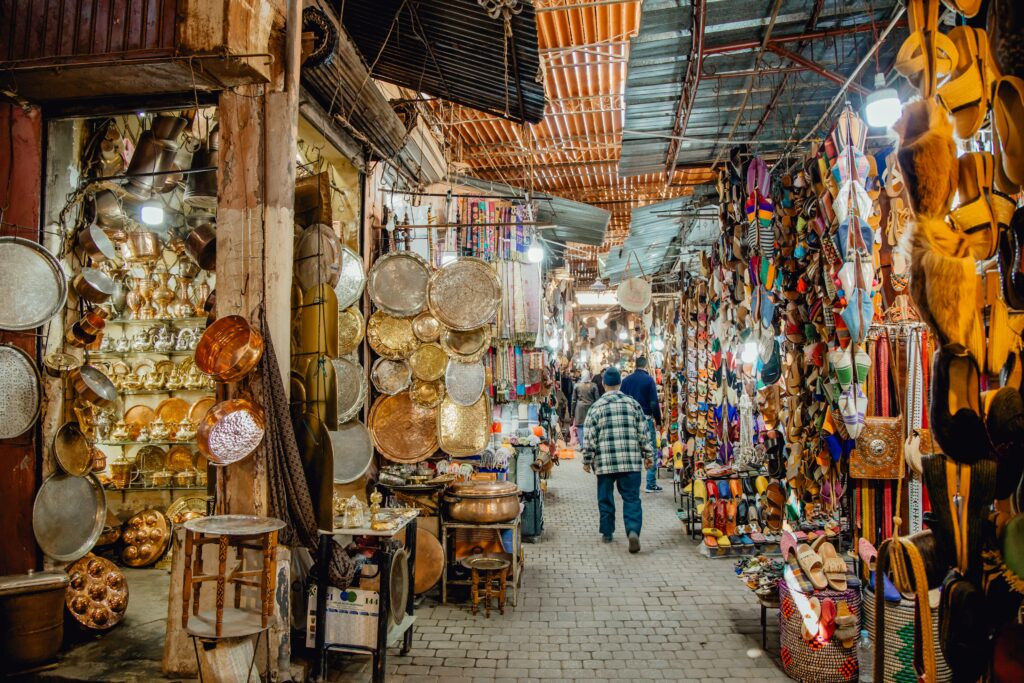
The medina of Tunis is a UNESCO World Heritage Site and one of the finest surviving examples of a medieval Arab city in the Mediterranean. The souk within it is organised on the principle of the medieval Arab commercial tradition: each trade has its own section of the market, and the sections are organised from the most prestigious trades near the central mosque to the less prestigious trades at the medina’s edges.
The perfumers and the bookbinders and the tailors of fine cloth are closest to the mosque. The leather workers and the dyers are at the edges, their trades requiring the smell and the mess that the mosque’s proximity does not permit.
This organisation has been largely unchanged for seven centuries, and walking from the mosque outward through the souk is walking backward through the social and economic hierarchy of the medieval Arab city in the form that it actually existed rather than in the form that the heritage presentation describes. The spice souk, in particular, is the eastern Mediterranean flavour vocabulary made material: the dried rose petals and the harissa and the ras el hanout and the preserved lemons and the specific North African spice combinations that the Naora chef buys here and that will appear in the food across the Indian Ocean legs where the trade route that produced these spices runs in the same direction as the Naora route.
Bali, the Pasar Pagi
The pasar pagi is the morning market: open from four in the morning and largely complete by eight, operating in the specific window before the heat and the tourist activity make the streets of Ubud or Denpasar or the harbour town above the anchorage something other than what they are at dawn.
The Bali morning market sells the day’s cooking requirements of the Balinese household: the coconut in fresh and grated and as milk, the galangal and the lemongrass and the kaffir lime leaves that form the aromatics foundation of the Balinese kitchen, the chillies in the varieties that the Balinese chilli taxonomy distinguishes more precisely than any European spice system, the flowers for the morning offerings that the Balinese Hindu tradition requires at the temple and at the household shrine and at the workshop and at the boat’s bow before it goes to sea.
What the three markets share is the specific window of the early morning: the hour before the market becomes the attraction rather than the necessity, before the tourist with the camera arrives to document what the local is simply doing.
The boat that comes in early enough to be in the market at the hour it belongs to, rather than at the hour it is convenient for the visiting schedule, sees the market as the city uses it rather than as the city presents it. This is the specific advantage of the boat that wakes up early, and the Naora boat, whose provisioning begins at seven and whose chef is in the market before the charter fleet has eaten breakfast, consistently has this advantage on every coast the route touches.